
 Forums
 Blogs
Blogs Articles
 File Library
 FAQ
FAQ Search
 FB
FB


Hello,
I am working on solving an existing operational problem where pressure spikes are experienced in the fuel gas system whenever one of Gas engines trips or is started-up. These pressure spikes lead to tripping a high-high or low-low pressure switches.
I simulated the fuel gas system using pipe segments and using the isometric drawings, control valves Cv's & characteristics from the datasheets and the volume of the existing buffer vessel from the datasheets.
The start-up of a gas engine has been simulated as opening the shutdown valve at the inlet of the user.
However, the Hysys model doesn't reflect the pressure spikes experienced at the site, and the only method to get a similar behavior as that experienced in the site is to De-tune the parameters of the controller.
But i can't understand why the Hysys model didn't reflect the actual behavior when using the tuning parameters that is being currently used in the site ?, taking into consideration that tuning the parameters of the controller in the site couldn't solve the problem and it seems that an additional buffer volume is required to dampen the effect of starting or tripping one of the gas engines.
Can anybody give me an explanation for the discrepancy in behavior between Hysys model and the real case ???,
Thanks in advance for your kind help,
|
|

Discrepancy In Behaviour Between Hysys & Reality In Fuel Gas Syste
Started by M-Engineer, Aug 13 2012 04:25 PM
4 replies to this topic
Share this topic:
#2

Dacs
-

- Members
-

- 457 posts
Gold Member
Posted 13 August 2012 - 06:03 PM
While I wont attempt to give a particular solution to your problem, but I realized that pressure spikes happens fairy quickly and it may be possible that your time step for your integrator is greater than what is expected for this spikes to last.
Have you tried making the time step smaller for your integrator?
Have you tried making the time step smaller for your integrator?
#3
M-Engineer
-
- Members
-
- 6 posts
Brand New Member
Posted 15 August 2012 - 09:18 AM
Dear Dacs,
Thanks for your kind reply, however, i am quite sure that the step size is not the cause of this discrepancy as I've tried before to use a very small step size (till 0.01 second), but the behavior haven't changed.
Please advise if you have any other factor that may have cause this discrepancy.
Regards,
Thanks for your kind reply, however, i am quite sure that the step size is not the cause of this discrepancy as I've tried before to use a very small step size (till 0.01 second), but the behavior haven't changed.
Please advise if you have any other factor that may have cause this discrepancy.
Regards,
#4
Mark-TR
-

- Members
-
- 37 posts
Veteran Member
Posted 10 September 2012 - 09:37 AM
Dear M-Engineer,
It is really difficult to know the causes of this peak of pressure without being on the field.
This is just an idea, but maybe what you are experience on the field is not what is being modeled.
It seems to me that what is happening is that sudden changes of velocity are producing sudden peak of pressures. This a behavior commonly produced by a surge or hydraulic hammer in pipeline.
I attach a copy of “a working guide for process equipment” where this phenomenon is explained.
It is possible that you may have accumulation of condensates in your fuel gas line or, if your fuel gas is at saturated conditions, the condensate may be produced with the contact to the cold pipe under the start-up. When you start or trip your engine the change of velocity creates a peak of pressure which may provide the peaks observed.
If this is the case, Hysys can not model the scenario. Hysys is not a tool created to simulate surge conditions by default.
I know you can manually add the surge dynamic equations, but I’ve never done it myself.
If you have interest on the dynamic of surge, I advise you to check “Fluid transients” of wylie et all or Perry´s hand book.
As Lieberman say “ No engineering calculation can be better than the assumptions used as basis to carry out the calculations”
Therefore, before any simulation is done, I advise you to check real data. Go to the field and see the phenomenon.
If condensate is observed at the start-up or the pipe is colder than the dew point of fuel gas, probably surge is happening.
Then you just need to drain and heat the pipe before introducing the fuel gas. You might also hear strong hits on the pipe if surge is happening.
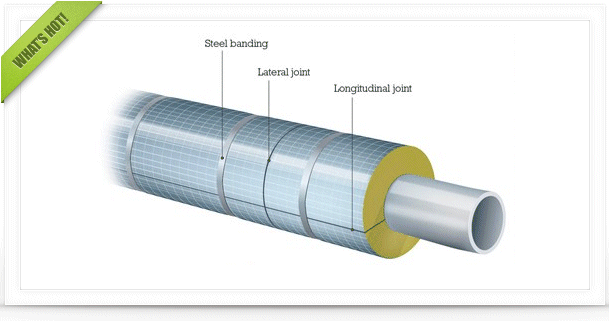
Check insulation, this may cool down the fuel gas. The fuel gas inlet line must be free draining to avoid condensates accumulation also.
Another practical solution (if it is possible, and operating temperature is close to the dew point) is to increase the fuel gas temperature .
I advise you to also consider the failure of instrumentation, the problem may be as simple as a wrong pressure transmiter selection or damage in the PT. Therefore, it is advisable to validate first in field data with a PG.
Kind regards
It is really difficult to know the causes of this peak of pressure without being on the field.
This is just an idea, but maybe what you are experience on the field is not what is being modeled.
It seems to me that what is happening is that sudden changes of velocity are producing sudden peak of pressures. This a behavior commonly produced by a surge or hydraulic hammer in pipeline.
I attach a copy of “a working guide for process equipment” where this phenomenon is explained.
It is possible that you may have accumulation of condensates in your fuel gas line or, if your fuel gas is at saturated conditions, the condensate may be produced with the contact to the cold pipe under the start-up. When you start or trip your engine the change of velocity creates a peak of pressure which may provide the peaks observed.
If this is the case, Hysys can not model the scenario. Hysys is not a tool created to simulate surge conditions by default.
I know you can manually add the surge dynamic equations, but I’ve never done it myself.
If you have interest on the dynamic of surge, I advise you to check “Fluid transients” of wylie et all or Perry´s hand book.
As Lieberman say “ No engineering calculation can be better than the assumptions used as basis to carry out the calculations”
Therefore, before any simulation is done, I advise you to check real data. Go to the field and see the phenomenon.
If condensate is observed at the start-up or the pipe is colder than the dew point of fuel gas, probably surge is happening.
Then you just need to drain and heat the pipe before introducing the fuel gas. You might also hear strong hits on the pipe if surge is happening.
Check insulation, this may cool down the fuel gas. The fuel gas inlet line must be free draining to avoid condensates accumulation also.
Another practical solution (if it is possible, and operating temperature is close to the dew point) is to increase the fuel gas temperature .
I advise you to also consider the failure of instrumentation, the problem may be as simple as a wrong pressure transmiter selection or damage in the PT. Therefore, it is advisable to validate first in field data with a PG.
Kind regards
Attached Files
-
 Working guide to process equipment.pdf 267.84KB
54 downloads
Working guide to process equipment.pdf 267.84KB
54 downloads
Edited by Mark-TR, 11 September 2012 - 02:38 AM.
#5
M-Engineer
-
- Members
-
- 6 posts
Brand New Member
Posted 15 September 2012 - 01:47 AM
Thanks alot Mark TR, however, it is not expected to have any condensate in the fuel gas system as there is a fuel gas heater which assures operating above the dewpoint by a margin of 15 deg C, even during startup a dewpointed gas is used. Thanks again for your kind advice.
Similar Topics

Importing Component Stream Data From Hysys To Excel Using VbaStarted by Guest_TimL_* , 17 Aug 2018 |
|

|
||
Sulfuric Acid Plant Aspen Hysys HelpStarted by Guest_kazuki222_* , 29 Apr 2026 |
|
|
||
Hysys Separator Carryover Setup And Phase EnvelopeStarted by Guest_powerox29_* , 05 Jan 2026 |
|
|
||
Handheld Ethanol Fuel Content AnalyzerStarted by Guest_Sciosophy_* , 03 Mar 2026 |
|
|
||
Beginner Question: Inlet Separator Design In Aspen Hysys (Natural Gas,Started by Guest_NewEng2030_* , 12 Feb 2026 |
|

|

