
philleckner.gif (7970 bytes)
A Monthly Column by Content Manager, Philip Leckner


"Process Engineering--As I See It"

smalllogo.gif (6368 bytes)

Rupture Disks for Process Engineers
(From the Process Design Engineer's Perspective)
Download a Printable Version Here (Adobe Acrobat Format)

More on Safety and Valves from Cheresources.com:
FREE Resources
Article: Complete Series on Relief Valves
Article: Rupture Pin Technology
Article: Sizing Control Valves
Questions and Answer: Safety Category
ChE Links: Search for "Valves"
Students: Ask a Question in our Forums
Professionals: Ask a Question in our Forums
Purchase / Subscription Resources
Book: Valve Selection Handbook
Online Store: Locating Pressure Relief Valves
Online Store: Safety Relief and Venting
Online Store: Control Valve Spec Sheet

Problem:

This is a real story. A rupture disk manufacturer presented a seminar to a group consisting of junior and more senior level process design engineers (yours truly included) with a few instrument engineers thrown in. After about an hour of hearing terms such as bursting pressure, tolerance, manufacturing range, etc., and discussions on the mechanical aspects that differentiate the various types of rupture disks, the seminar ended with many of those attending just shaking their heads. Most of the attendees just wanted to learn how to specify this item so the instrument engineer can buy one or the manufacturer can tell you what is needed.

asiseeit3a.gif (15968 bytes)

I eventually put together a seminar on rupture disks for process design engineers that went over very well. This series of articles is taken from that seminar. Part 1 covers the whys and when to use a rupture disk. Part 2 (next month) covers how to size the rupture disk. Subsequent parts will include how to set the burst pressure, the Relief Valve/Rupture Disk combination, how to specify the device and some discussion on the type of rupture disks you can purchase.

Before I begin, let me point out that most of what is included in this series of articles can be found in API RP5201 and API RP5212, and ASME Section VIII, Division 13.  Much of what is found in these documents can also be found in vendor literature.

Part 1: Why and when to use rupture disks.

Why do we use a stand-alone rupture disk?

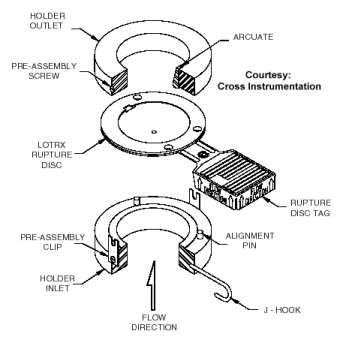
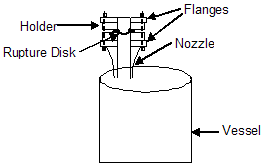
A rupture disk is just another pressure relieving device. It is used for the same purpose as a relief valve, to protect a vessel or system from overpressure that can cause catastrophic failure and even a death.

When do we use a stand-alone rupture disk?

Some of the more common reasons are listed below. You may think of others.
1.  Capital and Maintenance Savings: Rupture disks cost less than relief valves. They generally require little to no maintenance.

2.  Contents will be lost, but who cares? A rupture disk is a nonreclosing device, which means once it opens, it doesn’t close. Whatever is in the system will get out and continue to do so until stopped by some form of intervention. If loss of contents is not an issue, then a rupture disk may be the relief device of choice.

asiseeit3d.gif (2839 bytes)

3.  Benign service: It is preferable that the relieving contents be non-toxic, non-hazardous, etc. However, this is not a requirement when deciding to use, or not use, a stand-alone rupture disk.

4.  Rupture disks are extremely fast acting: Rupture disks should be considered first when there is a potential for runaway reactions. In this application, relief valves will not react fast enough to prevent a catastrophic failure. A relief valve may still be installed on the vessel to protect against other relieving scenarios. Some engineers prefer to use rupture disks for heat exchanger tube rupture scenarios rather than relief valves. They are concerned that relief valves won’t respond fast enough to pressure spikes that may be experienced if gas/vapor is the driving force or liquid flashing occurs.
5.  The system contents can plug the relief valve during relief: There are some liquids that may actually freeze when undergoing rapid depressurization. This may cause blockage within a relief valve that would render it useless. Also, if the vessel contains solids, there is a danger of the relief valve plugging during relief.

6.  High viscosity liquids. If the system is filled with highly viscous liquids such as polymers, the rupture disk
should seriously be considered as the preferable relieving device. Flow through a relief valve will be very difficult to calculate accurately. Also, very viscous fluid may not relieve fast enough through a relief valve.

Cost comparison between comparable stand-alone rupture disk and relief valve.

Rupture disk manufacturers burst at least two disks per lot before shipping them to a customer. As a consequence even if you want just one rupture disk you will be buying three. Therefore, the first usable rupture disk is comparatively expensive. Also for new installations, each installed rupture disk must be purchased along with a holder. However, the same holder may be used for replacement purchases as long as you buy the exact same rupture disk from the same manufacturer.

Below is a capital cost comparison between Continental Disc Corp. (www.contdisc.com) 3” Ultrx Hastelloy C rupture disks with holders and Farris Engineering (www.cwfc.com) 2600 series relief valves, based on a budget estimate in year 2001 dollars.

Basis: Continental Disc

Basis: Farris Engineering

3” Ultrx Hast C Disc = $2,600 for 1st usable disk, then $870 each

3” x 4” Hast C 26KA10-120 = $13,400

3” Ultrx Hast C Holder = $3,300 ea.


TOTAL for one pair = $5,900


TOTAL for three pair = $14,240

TOTAL for three = $40,200

This capital cost comparison will vary considerably with size and material of construction but you get the point. However please note that everything has a value and the loss of contents should be considered in the overall cost difference between a rupture disk and a relief valve.

When do we use a rupture disk-relief valve combination?

asiseeit3b.gif (1619 bytes)

Rupture disks are often used in combination with and installed just upstream and/or just downstream of a relief valve.  You may want to choose the combination option if:

1.  You need to ensure a positive seal of the system (the system contains a toxic substance and you are concerned that the relief valve may leak). Application: rupture disk installed upstream of the relief valve.

2.  The system contains solids that may plug the relief valve over time. Remember, the relief valve is continuously exposed to the system. Application: rupture disk installed upstream of the relief valve.

3.  TO SAVE MONEY!  If the system is a corrosive environment, the rupture disk is specified with the more exotic and corrosion resistant material. It acts as the barrier between the corrosive system and the relief valve. Application: rupture disk installed either upstream and/or downstream of the relief valve.

Below is a capital cost comparison between combination Hastelloy C rupture disks with stainless steel relief valves and three stand-alone Hastelloy C relief valves. Again, this is based on a budget estimate in year 2001 dollars using Continental Disc Corp. rupture disks and holders and Farris Engineering relief valves.

Basis: Continental Disc

Basis: Farris Engineering

3” Ultrx Hast C Holder = $3,300

3” x 4” Hast C 26KA10-120 = $13,400


3” Ultrx Hast C Disc = $2,600 for 1st usable disk, then $870 each

3” x 4” SS 26KA10-120 = $4,300


Combination of Hastelloy C Disc & SS Relief Valve

Single Installation Total = $10,200

Total for three installations = $27,140

Three stand-alone Hastelloy C relief valves = $40,200

asiseeit3c.gif (4230 bytes)

Summary

A stand-alone rupture disk is used when:

  1. You are looking for capital and maintenance savings

  2. You can afford to loose the system contents

  3. The system contents are relatively benign

  4. You need a pressure relief device that is fast acting

  5. A relief valve is not suitable due to the nature of the system contents

A rupture disk / relief valve combination is used when:

  1. You need to ensure a positive seal of the system
  2. The system contains solids that may plug the relief valve over time
  3. TO SAVE MONEY!  If the system is a corrosive environment, the rupture disk is specified with the more exotic and corrosion resistant material


References: 

  1. API (www.api.org) Recommended Practice 520, "Sizing, Selection, and Installation of Pressure-Relieving Device in Refineries, Part 1-Sizing and Selection", 7th Edition (January 2000)
  2. API (www.api.org) Recommended Practice 521, "Guide for Pressure-Relieving and Depressuring Systems", 4th Edition (March 1997)
  3. ASME (www.asme.org) "Boiler and Pressure Vessel Code, Section VIII, Division 1" (1998)


By: Philip Leckner, First Content Manager (read the author's Profile)
pleckner@hotmail.com


ChE Plus Subscriber - Click Here for a Printable Version

Send this Page to a Friend

Fill out your email address to
receive notification of site updates
and instantly receive five technical
questions and answers
!
Email Address:
First Name:
Last Name:

State:

Country:

Industry:

Position:

Signup Remove