
 Forums
 Blogs
Blogs Articles
 File Library
 FAQ
FAQ Search
 FB
FB
Latest Downloads
-
 Water Bath Indirect Heaters
Art Montemayor - Oct 12 2018 02:35 PM
-
Petroleum: A Primer for Kansas
Art Montemayor - Oct 12 2018 02:27 PM
-
 Spray Tower for Flue Gas Scrubbing Design
ankur2061 - May 02 2018 02:31 PM
-
Selection of Vertical Tanks
ankur2061 - Apr 19 2018 07:42 AM
-
Pressure Drop Calculator for Strainers 1
ankur2061 - Mar 24 2017 02:04 PM
-
Horizontal Pig Trap System Design Guidelines
ankur2061 - Jan 14 2017 02:54 PM
-
Performance Prediction of 3-Stage Propane Refrigeration System
ankur2061 - Aug 08 2016 02:43 PM
-
Centrifugal Pump Troubleshooting Checklist
ankur2061 - Dec 17 2015 08:18 AM
-
Compressor Troubleshooting Checklist
ankur2061 - Sep 08 2015 11:43 AM
-
Amine Sweetening Unit Preliminary Design
ankur2061 - May 19 2015 09:35 AM
Popular Store Titles
 Tank Jacket Calculator
- Specification Sheet Collection
- PIPESIZE
- Relief Valve Sizing
- Rupture Disc Sizing
Chemical and Process Engineering Resources
 4
4
Safety and Pressure Relief


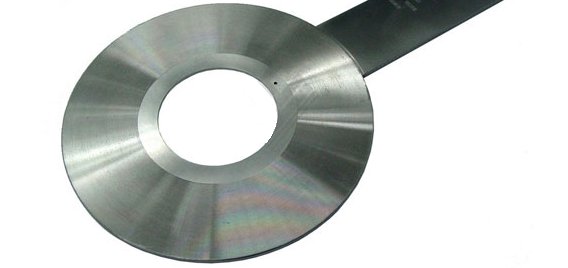
Flow Through Orifice Plates in Compressible Flu...
Nov 08 2010 01:40 PM |
dkirk
in Safety and Pressure Relief
The calculation of compressible flow through orifice plates at high dP (critical flow) appears to be carried out incorrectly in most instances. This flow condition is often encountered on gas plants, compressor stations and pipelines where orifice plat...
Read story → 0 comments


 high, pressure, orifice, flow and 2 more...
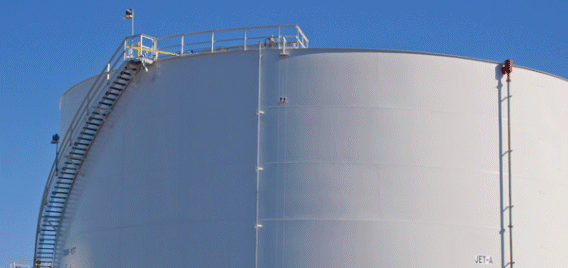
Tank Blanketing Basics Covered
Nov 08 2010 01:40 PM |
proinwv
in Safety and Pressure Relief
Tank blanketing, or padding, refers to applying a cover of gas over the surface of a stores commodity; usually a liquid. Its purpose is either to protect or contain the stored product or prevent it from harming personnel, equipment, or the environment....
Read story → 2 comments
tank, blanket, blanketing, basics
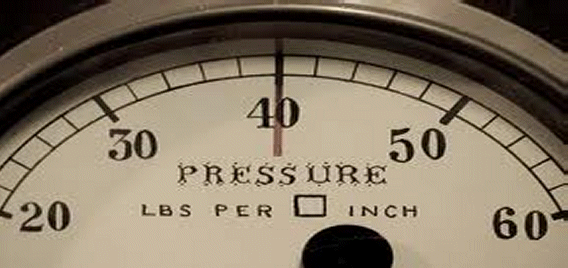
Relieve Valve Set Pressures
Nov 08 2010 01:20 PM |
pleckner
in Safety and Pressure Relief
As the title of this column implies, I intend to present various topics related to Process Engineering Design based on my knowledge and experiences. I will convey what approaches I think you should be taking. I will stress "the correct way" so don't ex...
Read story → 0 comments
Pyrophoric Iron Fires
Nov 08 2010 01:30 PM |
Mukesh Sahdev
in Safety and Pressure Relief
At one time or another, most refineries experience spontaneous ignition of iron sulfide either on the ground or inside equipment. When this occurs inside equipment like columns, vessels, and tanks and exchangers containing residual hydrocarbons and air...
Read story → 1 comments
Rupture Disks for Process Engineers - Part 6
Nov 08 2010 01:30 PM |
pleckner
in Safety and Pressure Relief
Part 1 of this series on rupture disks for Process Engineers covered why you use a rupture disk and when you might want to use this device. Part 2 discussed how to size the rupture disk. Part 3 discussed how to set the burst pressure. Part 4 discussed...
Read story → 0 comments
Rupture Disks for Process Engineers - Part 5
Nov 08 2010 01:30 PM |
pleckner
in Safety and Pressure Relief
Part 1 of this series on rupture disks for Process Engineers covered why you use a rupture disk and when you might want to use this device. Part 2 discussed how to size the rupture disk. Part 3 discussed how to set the burst pressure. Part 4 discussed...
Read story → 0 comments
Rupture Disks for Process Engineers - Part 4
Nov 08 2010 01:30 PM |
pleckner
in Safety and Pressure Relief
Part 1 of this series on rupture disks for Process Engineers covered why you use a rupture disk and when you might want to use this device. Part 2 discussed how to size the rupture disk. Part 3 discussed how to set the burst pressure. In this part, I w...
Read story → 0 comments
Rupture Disks for Process Engineers - Part 3
Nov 08 2010 01:30 PM |
pleckner
in Safety and Pressure Relief
Part 1 of this series on rupture disks for Process Engineers covered why you use a rupture disk and when you might want to use this device. Part 2 discussed how to size the rupture disk. In this part, I will cover how to set the burst pressure. Subsequ...
Read story → 0 comments
Rupture Disks for Process Engineers - Part 2
Nov 08 2010 01:30 PM |
pleckner
in Safety and Pressure Relief
Part 1 of this series on rupture disks for Process Engineers covered why you use a rupture disk and when you might want to use this device. This part will discuss how to size the rupture disk. Subsequent parts will include how to set the burst pressure...
Read story → 0 comments
Rupture Disks for Process Engineers - Part 1
Nov 08 2010 01:30 PM |
pleckner
in Safety and Pressure Relief
This is a real story. A rupture disk manufacturer presented a seminar to a group consisting of junior and more senior level process design engineers (yours truly included) with a few instrument engineers thrown in. After about an hour of hearing terms...
Read story → 1 comments
Relief Valves: "What Can Go Wrong" Scen...
Nov 08 2010 01:30 PM |
pleckner
in Safety and Pressure Relief
What can go wrong in a chemical facility? Plenty! A report in the August 2000 issue of CEP1 shows that operator error or poor maintenance was the leading of cause of accidents for unfired pressure vessels eight years running. The ProblemAccidents not o...
Read story → 0 comments