
 Forums
 Blogs
Blogs Articles
 File Library
 FAQ
FAQ Search
 FB
FB
Chemical and Process Engineering Resources


The preferred method of separation in the chemical industry, distillation, is a very energy intensive process. Fine tuning your distillation columns (and in some cases, making major changes) can save your company thousands of dollars a year or more. Consider the following distillation column shown in Figure 1 and detailed in Table 1:
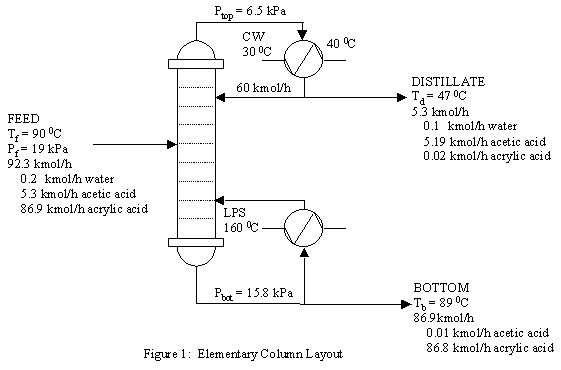 |
| Figure 1: Distillation Column |
We'll examine this column and with some help from the Tower Pricing and Sizing Add-In, we'll see how small changes can save you money in energy costs.
Check the Product Purity
Rating: Little to no investment
Many companies tend to excessively purify products and sometimes with good reason. However, purifying to 98% when 95% is acceptable is just not necessary. In this case, the reflux rate should be decreased in small increments until the desired purity is obtained. In our example, the current reboiler duty will require $68,000 in low pressure steam per year. However, if the purity is decreased and the duty in the reboiler decreases by 5% (down to 2545 MJ/h), the cost of steam decreases to $64,500.
Summary: Excess purification was causing increased spending in the amount of $3,500 per year in the reboiler alone.
Seasonal Operating Pressure Adjustment
Rating: Little or no investment
For plants that are in locations that experience winter climates, the operating pressure can be reduced according to a decrease in cooling water temperatures. Although lowering the pressure in our column would actually be an expense since it's under vacuum, this would not always be the case. The lower pressure will facilitate separation thus lowering energy consumption.
Summary: Take advantage of lower temperatures outside.
Summary: One example of heat integration yields an annual savings of $5,300 per year. A good economic analysis of this option will tell you if it's right for your situation.
Feed Temperature (C) | 90.0 |
| Feed Pressure (kPa) | 19.0 |
| Top Pressure (kPa) | 6.5 |
| Bottom Pressure (kPa) | 15.8 |
| Reflux Ratio | 12.2 |
| Rmin | 1.18 |
| Feed Stage | 9 |
| Number of Actual Trays | 31 |
| Tray Efficiency | 78% |
| Diameter (m) | 1.2 |
| Length (m) | 22 |
| Flooding | 53% |
| Condenser Heat Duty (MJ/h) | -2726 |
| Reboiler Heat Duty (MJ/h) | 2679 |
| Acrylic Acid Purity | 99.9% |
0 Comments