|
Heat transfer is one of
the most important industrial processes. Throughout
any industrial facility, heat must be added, removed, or moved from one process stream to
another. Understanding the basics of the heart
of this operation is key to any engineers mastery of the subject. There are three basic types of heat transfer:
conduction, convection, and radiation. The two
most common forms encountered in the chemical processing industry are conduction and
convection. This course will focus on these
key types of heat transfer. Any overall energy
balance starts with the following equations:

Where: Q = heat
transferred in thermal unit per time (Btu/h or kW) M = mass flow rate T = temperature Cp = heat capacity
or specific heat of fluid Subscript
H = hot fluid Subscript
C = cold fluid In theory, the heat
given up by the hot fluid is never exactly equal to the heat gained by the cold fluid due
to environmental heat losses. In practice,
however, they are generally assumed to be equal to simplify the calculations involved. Any environmental losses are generally minimized
with insulation of equipment and piping. When examining
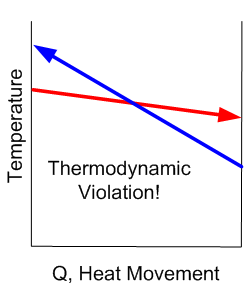
industrial systems, it is common practice to use a graphical form of these equations know
as T-Q diagrams to enhance understanding and to make sure that the Second Law
of Thermodynamics is not disobeyed. In other
words, heat can only move from a higher to a
lower temperature fluid. Here is how the
generic diagram is constructed:
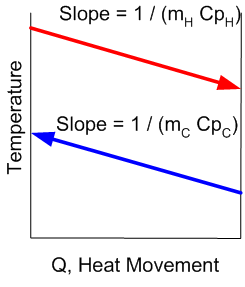
Its easy to
see how viewing a particular heat transfer problem in this way is extremely valuable. Now thats
weve seen how heat moves from a hot fluid to a cold fluid, lets examine the
third basic equation that is used to govern the equipment used for transferring heat. The Heat
Exchanger Equation takes the form:
Where: Q = heat transferred
in thermal unit per time (Btu/h) f = temperature
correction factor U = overall heat
transfer coefficient (Btu/h ft2 °F) A = heat transfer
area (ft2) LMTD = log mean
temperature difference These three (3)
equations are the basis for virtually all heat exchanger design.
Examining the Heat Exchanger Equation If we take a closer
look at the heat exchanger equation, its worth noting some assumptions that are made
in its derivation. First, the overall heat
transfer coefficient and the specific heat (also called heat capacity) of the fluids are
assumed to remain constant through the heat exchanger.
If we look at the
change in the heat capacity of water, for example, over a reasonable temperature range,
here is what we find: Specific heat of
water at 100 °F and atmospheric pressure = 0.9979 Btu / lb °F Specific heat of
water at 210 °F and atmospheric pressure = 1.0066 Btu / lb °F So, we can see that
this is a fairly reasonable assumption for water and it remains reasonable for most
industrial fluids. The specific heat of a
substance is defined as the amount of heat required to raise the temperature of one pound
of the substance by a single degree Fahrenheit (other units can apply as well). The overall heat
transfer coefficient is a calculated variable based on the physical properties of the
fluids involved in the heat transfer (hot and cold) as well as the geometry and type of
heat exchanger to be used. Well examine
this closer a little later. The log mean
temperature difference or LMTD is used to describe the average temperature difference
throughout the exchanger. The difference
between the temperatures of the fluids provides the driving force for the heat
transfer to occur. The larger the temperature
difference, the smaller the required heat exchanger and vice versa. Youll notice
from our T-Q diagram used to explain the equations:
that it appears that
the temperature difference between the fluids remains almost constant throughout the heat
exchanger. This is rarely the case. Lets look at a more practical example. Lets assume that a process stream containing
water at 200 °F is to be cooled to 150 °F using cooling tower water available at 85 °F. It is common practice in industry to return cooling
tower no higher than 120 °F. In other words,
the cooling tower water flow must be such that its outlet temperature from the heat
exchanger is less than 120 °F. The reason for
this is that cooling tower water often contains treatment chemicals that can plate out
onto heat transfer surfaces and cause severe fouling or degradation of the heat transfer
rate at elevated temperatures. Here is what the T-Q
diagram may look like for our example case:
You can see that the
temperature difference between the two streams will vary widely. This is why the log mean temperature difference is
used. Here is how the log mean temperature
difference works:
So, for a heat exchanger
as described above, we calculate the LMTD as follows:
There can be special
cases where the LMTD equation shown above is not applicable.
Consider the case below.
If you tried apply the
LMTD equation to this special case, youd find that the result would be zero. In this case the LMTD is the same as the
temperature difference on each end of the heat exchanger, or 100 °F.
A Brief Word on Flow Direction Notice that up to
this point, the two fluids considered in a heat exchanger have been moving in opposite
directions to one another. This is known as
counter-current flow. This is the
predominantly preferred flow direction because it results in higher temperature difference
driving forces within the heat exchanger, thus minimizing the heat transfer area required. The other flow
configuration, where the fluids flow in the same direction, is called co-current flow. Co-current flow, while it is rarely used, does have
the advantage of lowering the heat exchanger wall temperature on the hot side fluid. This can be useful for temperature sensitive fluids
or as a means of minimizing deposits that are temperature sensitive.
The Temperature Correction Factor, f The temperature
correction factor, f, is used to correct the log mean temperature difference for heat
exchangers than lack truly counter-current flow. Many
different heat transfer technologies lack truly counter-current flow patterns as a result
of their inherent mechanical design. Generally,
the value for f should be between 0.75 of 0.97. There
are cases when this value can be taken as one, but only if the flow in the exchanger is
purely counter-current. There are countless
charts available to look up the temperature correction factor for a given configuration.
The Overall Heat Transfer Coefficient The overall heat
transfer coefficient describes the rate of heat transfer in the heat exchanger. Generically, it is described by the following
equation:
Where: U = overall heat
transfer coefficient (Btu / h ft2 °F) hH = hot
side heat transfer coefficient hC = cold
side heat transfer coefficient Delta x = exchanger
wall thickness k = exchanger wall
material thermal conductivity Rf =
fouling coefficient (h ft2 °F / Btu) The equation for the
overall heat transfer coefficient is often reduced to the following:
because the term
Delta x / k seldom has any significant impact on the overall U-value. The overall heat
transfer coefficient can either be calculated, looked up in reference materials for a
given duty, estimated from past plant experience, or supplied by a heat exchanger vendor.
Brief Overview of Heat Exchanger Types In the chemical
processing industry, there are numerous types of heat exchanger devices. The types of exchangers can be classified by the
duty that they perform, surface compactness, construction features, flow arrangements, and
others. In general, a heat exchanger can fall
into one of these processing categories: No Phase Change Liquid to Liquid
heat transfer Liquid to Gas heat
transfer Gas to Gas heat
transfer Phase Change Condensing a vapor
with a liquid or gas service fluid Vaporizing a liquid
with a liquid, gas, or condensing fluid Heat exchangers
can also be broken down into the following two types of mechanical geometries: Shell and Tube Heat
Exchangers Compact and Extended
Surface Heat Exchangers Approximately 70-80%
of the heat exchanger market is dominated by the shell and tube type heat exchanger. It is largely favored due to its long performance
history, relative simplicity, and its wide temperature and pressure design ranges. We will explore this technology in further detail
later. The second category
mentioned, compact and extended surface heat exchangers, play a smaller role in the
chemical processing industry. Some of the
available technologies that fit into this category are the plate and frame heat exchanger,
finned tube heat exchangers, spiral heat exchangers, fin-fan heat exchangers, and many
others. Compact Heat Exchanger Technologies The plate exchanger,
shown below, consists of corrugated plates assembled into a frame. The hot fluid flows in one direction in alternating
channels while the cold fluid flows in true countercurrent flow in the opposite
alternating channels. The fluids are directed
into their proper channels either by a rubber gasket or a weld depending on the type of
exchanger chosen. Traditionally, plate
and frame exchangers have been used almost exclusively for liquid to liquid heat transfer. Today, many variations of the plate technology have
proven useful in applications where a phase change occurs as well. This includes condensing duties as well as
vaporization duties. Plate heat exchangers are
best known for having overall heat transfer coefficients (U-values) in excess of 3-5 times
the U-value in a shell and tube designed for the same service. Plate exchangers can
be especially attractive when more expensive materials of construction are required. The significantly higher U-value results in far
less area for a given application, thus a lower purchased and installed cost due to its
relatively small size. The higher U-values are
gained by inducing extremely high wall shear on the plate surface. The best way to think of a plate heat exchanger is
that it is essentially a static mixer that happens to transfer heat very well. The plate exchanger, by virtue of its high wall
shear stress also minimizes fouling very well. Typical plate
thicknesses range from 0.40 mm to 0.60 mm and passage channel openings can range from 1.5
mm up to 11.0 mm depending on the application and required design pressure (the larger the
opening, the lower the design pressure available). These
small passages also restrict the size of solids that can be successfully passed through
the exchanger.
Perhaps the biggest
advantage of the plate and frame heat exchanger, and a situation where it is most often
used, is when the heat transfer application calls for the cold side fluid to exit the
exchanger at a temperature significantly higher than the hot side fluid exit temperature. This situation is best explained with another set
of T-Q diagrams:
Duty 1 shown above
is easily accomplished in a single and tube heat exchanger.
Duty 2 shows a
severe temperature cross or the cold side fluid exiting higher than the hot
side fluid. This would require several shell
and tube exchangers in series due to the lack of purely counter-current flow. On the other hand, this duty is easily accomplished
in a single plate and frame heat exchanger. Finned tube heat
exchangers are commonly used to transfer heat between a gas and liquid. The tubes used in these units are equipped with
fins that extend outward from the tubes as shown below.
The fins on the
tubes allow for a much larger surface area to be packed into a small volume. This is especially important when transferring heat
to or from a gas as gasses have extremely low heat transfer coefficients (meaning that
large amounts of area are required). Fin-fan heat
exchangers are designed to use air to cool process fluids.
Think of them as a giant radiator. The
process fluid is passed through the coils and a fan helps pull air over the outside
surface to promote cooling. These units again
must provide a very large surface area to make up for the poor heat transfer of the air.
Shell and Tube Heat Exchanger Technologies Shell and tube heat
exchangers are known as the work-horse of the chemical process industry when it comes to
transferring heat. These devices are available
in a wide range of configurations as defined by the Tubular Exchanger Manufacturers
Association (TEMA, www.tema.org). In essence, a shell and tube exchanger is a
pressure vessel with many tubes inside of it. One
process fluids flows through the tubes of the exchanger while the other flows outside of
the tubes within the shell. The tube side and
shell side fluids are separated by a tube sheet.
The shell and tube
type is usually indicated as a three (3) letter code from the TEMA specifications shown
below:
The shell side of a
shell and tube exchanger usually contains baffles as shown above to direct the shell side
flow around the tubes to enhance heat transfer. As
you can see, shell and tube exchangers can be configured for liquid-liquid, gas-liquid,
condensing, or vaporizing heat transfer. The tubes can be a
different material than shell and the shell can either be cladded or of solid
construction. Its impossible to go over
all of the mechanical details of the shell and tube here, but this should provide you with
a general overview of the construction. There
are numerous other sources of information freely available on these types of units. The tubes and shell
can be designed for a variety of design temperatures and pressures. The thermal design
of shell and tube heat exchangers is often performed by vendors. The process engineer generally completes a TEMA
specification sheet and submits it to vendors for bids.
If youre interested in more details on the thermal design
aspects of shell and tube heat exchangers, you can visit Wolverine Engineerings
website at: http://www.wlv.com/products/databook/databook.pdf This online design
manual is extremely well done and is a valuable, freely available resource. There are well
documented sources of estimated overall heat transfer coefficients and fouling factors
that can be specified. Fouling factors are
historic safety factors that allow for the oversizing of a shell and tube in anticipation
of eventual surface build-up that will form a resistance to heat transfer. Remember, the overall heat transfer coefficient of
a new heat exchanger will slowly degrade over time until it levels off to what
is known as the service U-value. This
is the actual rate of a heat transfer that the unit will achieve on a nominal basis. The combination of a well selected U-value and a
fouling factor should ensure a good shell and tube design.
Typical U-values for various services and fouling factors can be found on
the internet or in various text references. Included with this
course is a MS Excel spreadsheet that can be downloaded and used to specify heat transfer
equipment. There is a version which uses U.S.
Customary units as well as a version which employs SI units. Understanding the basics of industrial heat transfer will help you better understand opportunities for cost savings in your plant. With energy prices showing no sign of declining, a good basis in heat transfer will help you calculate just how much you can save by installing a new heat exchanger in your plant. With the use a T-Q diagram and a basic understanding of the equipment available to you, making the right choice in heat transfer equipment can yield results for years to come. By: Christopher Haslego, Owner and Chief Webmaster (read the author's Profile) |
ChE Plus Subscriber - Click Here for a Printable Version
Send this Page to a Friend