
philleckner.gif (7970 bytes)
A Monthly Column by Content Manager, Philip Leckner


"Process Engineering--As I See It"

smalllogo.gif (6368 bytes)

Rupture Disks for Process Engineers
(From the Process Design Engineer's Perspective)
Part 5: The Relief Valve/Rupture Disk Combination
Download a Printable Version Here (Adobe Acrobat Format)

More on Safety and Valves from Cheresources.com:
FREE Resources
Article: Complete Series on Relief Valves
Article: Rupture Pin Technology
Article: Sizing Control Valves
Questions and Answer: Safety Category
ChE Links: Search for "Valves"
Students: Ask a Question in our Forums
Professionals: Ask a Question in our Forums
Purchase / Subscription Resources
Book: Valve Selection Handbook
Online Store: Locating Pressure Relief Valves
Online Store: Safety Relief and Venting
Online Store: Control Valve Spec Sheet

Part 1 of this series on rupture disks for Process Engineers covered why you use a rupture disk and when you might want to use this device. Part 2 discussed how to size the rupture disk. Part 3 discussed how to set the burst pressure. Part 4 discussed how temperature and backpressure affects the rupture disk specification and the relief pressure in the system. In this part, I will discuss the Relief Valve/Rupture Disk combination. Subsequent parts will include how to specify the rupture disk and some discussion on the type of rupture disks you can purchase. Before I begin, let me point out that most of what is included in this series of articles can be found in API RP5201 and API RP5212, and ASME Section VIII, Division 13.  Much of what is found in these documents can also be found in vendor literature.

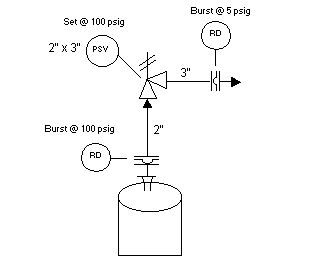
For the relief valve/rupture disk combination (Figure 1), rupture disk sizing is totally dependent on relief valve sizing, regardless whether the rupture disk is installed upstream or downstream of the relief valve. Consequently, the discussion at this point must turn to a brief overview of relief valves.

asiseeit7a.gif (4001 bytes)

Relief Valve Sizing Overview

Basically, the relief valve is treated as an ideal nozzle, i.e. isentropic (constant entropy) flow. A correction factor, the coefficient of discharge, is incorporated into the sizing equations to take into account the fact that this is not an ideal nozzle. The sizing equations themselves can be found in one or more of the references presented at the end.

To size a relief valve, the process engineer first determines the required relieving flow and fluid properties based on an analysis of “what can go wrong” scenarios. The flow and properties are then inserted into the appropriate sizing equation to arrive at a calculated relief valve area. If this were a stand-alone relief valve, the process engineer would use this calculated relief valve area to choose an actual relief valve from a vendor catalog. But since this is a discussion of the relief valve/rupture disk combination, adjustments should be made to the calculated relief valve area before the actual relief valve is chosen.
The Rupture Disk Affect

The presence of a rupture disk acts to de-rate the relief valve capacity. This de-rating factor, called the Combination Capacity Factor (CCF), may or may not be implicitly included in the sizing formulas. Nevertheless, it is the responsibility of the process engineer to apply the factor correctly.

The Combination Capacity Factor (CCF)

The Combination Capacity Factor (CCF) is a calculated value that is derived from data obtained during certified capacity testing of the stand-alone relief valve and the relief valve/rupture disk combination. The manufacturer first determines the capacity of the stand-alone relief valve. The rupture disk is then added, close-coupled, to the inlet of the relief valve and the capacity of the relief valve/rupture disk combination is determined. Finally, the CCF is calculated as the ratio of the relief valve/rupture disk combination capacity to the stand-alone relief valve capacity:

CCF = Flow Combination Capacity / Flow Stand-Alone Relief Valve Capacity

Below is a list of certified Combination Capacity Factors for the Continental Disc Corporation model ULTRX ® rupture disks with the Crosby JOS/JBS Relief Valve 4.

Rupture Disk Size

Burst Pressure, psig

Material

CCF

1”

60 minimum

Nickel

0.981

Stainless Steel

0.980

3”

30 - 59

Nickel

0.981

Stainless Steel

0.984

For comparison, the following is a list of certified Combination Capacity Factors for the Fike model MRK?? rupture disk with the Crosby JOS/JBS Relief Valve5.

Rupture Disk Size

Burst Pressure, psig

Material

CCF

1”

60 minimum

Nickel

0.977

Stainless Steel

0.967

3”

35 minimum

Nickel

0.995

Stainless Steel

0.982

Note that the CCF is a certified value and is only good for the design of the relief valve and the rupture disk that are used in the test. Since it is in the best interest of the rupture disk manufacturer to certify as many of their rupture disk designs with as many different types of relief valve designs as possible, it is typical for the rupture disk manufacturer to perform this testing and reporting of the CCF. The certified CCF will always be less than or equal to 1.0.

If the manufacturer and/or model of the rupture disk and relief valve are unknown at the time of sizing, or there is no published value for a relief valve/rupture disk combination, ASME3 requires that the CCF is not to exceed 0.9.

Applying the CCF

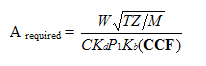
API Recommended Practices 5201 shows the CCF as being applied to the denominator of the relief valve sizing equation. For example, a typical sizing equation for gas relief might look something like this:
asiseeit7b.gif (1955 bytes)

Where:
W = required relieving rate, mass flow
T  = relieving temperature, absolute
Z  = compressibility factor
M = molecular weight
C = gas constant = a function of (Cp / Cv)
Cp = specific heat at constant pressure (consistent units)
Cv = specific heat at constant volume (consistent units)
Kd = coefficient of discharge, dimensionless
Kb = backpressure correction factor, dimensionless
P1 = relief pressure (absolute)

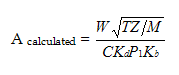
Note that this is the same as dividing the calculated, stand-alone relief valve area by the CCF to arrive at a required relief valve area for the combination unit:
asiseeit7f.gif (1820 bytes)
And:

A required = A calculated / CCF

The process engineer will use this required relief valve area as the basis for choosing a relief valve from the vendor catalog.

One important thing to note is that the preceding methodology is not a requirement of code (ASME). ASME only requires that the stand-alone relief valve’s certified flow capacity be de-rated by the CCF:

Flow Combination Certified Capacity = Flow Stand-Alone Relief Valve Certified Capacity x CCF

There is no mention of using the CCF to arrive at a relief valve area. Indeed, prior to the most recent edition of API RP5201, the sizing equations themselves did not explicitly include a correction factor for the relief valve/rupture disk combination.

Note also that de-rating the certified flow capacity is only required if the rupture disk is installed upstream of the relief valve, it is not required if installed downstream of the relief valve.

Certified (Rated) Capacity

As stated above, each stand-alone relief valve will have associated with it a certified flow capacity, which is a function of both the relief valve area and the set pressure. This flow is determined by certified capacity testing procedures and is to be considered the guaranteed flow rate that can be achieved through the particular valve. With very few exceptions, this flow is used in determining both the relief valve inlet and outlet (tail pipe) line sizes. The certified flow capacity is officially stamped on the relief valve documentation. For relief valve/rupture disk combinations, the de-rated certified flow will also be stamped on the documentation.

Although the relief valve is chosen based on area, the process engineer must still ensure that the certified flow capacity is greater than or equal to the required relieving flow:

Certified Flow Capacity ³ Required Relieving Flow

If it is not, the chosen relief valve is too small. For the relief valve/rupture disk combination, the required relieving flow would be compared to the de-rated or combination certified flow capacity:

Combination Certified Flow Capacity ³ Required Relieving Flow

Relief Valve Sizing Overview

Inlet Line

The relief valve inlet line is defined as the piping between the inlet to the system (e.g. the inlet to a vessel nozzle) and the relief valve inlet flange. Sizing this inlet line is a trial-and-error procedure. First, the process engineer chooses a line size using guidelines set by code; code requires that the flow area of the line and all associated piping components be at least equal to the relief valve inlet flow area. Then, using accepted fluid flow equations (e.g. Darcy for single phase liquid or gas/vapor and DIERS for two phase) and the certified flow capacity of the stand-alone relief valve the non-recoverable frictional losses in the line are determined. The sum of all non-recoverable losses should be less than 3% of the relief valve set pressure, this criteria is commonly referred to as the 3% Rule. In general, if the 3% Rule is exceeded then the chosen line size is too small.

Outlet Line (Tail Pipe) Sizing Overview

The sizing of the tail pipe is done in a similar manner to that outlined above for the inlet line. The process engineer first chooses a pipe size. Then, using accepted fluid flow equations (e.g. Darcy for liquids, Isothermal or Adiabatic for gas/vapor and DIERS for two-phase) and the same certified flow capacity as used for the inlet line, a built-up (variable) backpressure is calculated. The built-up backpressure is converted to a percentage of the relief valve set pressure and is then compared to some maximum value that is set by the particular relief valve manufacturer. For example, tail pipes on conventional style relief valves would be sized such that the built-up (variable) backpressure does not exceed 10% of the relief valve set pressure. For balanced bellows style relief valves, tail pipes would be sized such that the built-up (variable) backpressure does not exceed 30% to 55% of the relief valve set pressure, depending on manufacturer. If the calculated percentage is less than or equal to these maximums, the line size is acceptable. If the calculated percentage is greater, the line size may or may not be acceptable. This is because the only requirement of code is that the built-up backpressure does not affect the relief valve’s ability to relieve the required amount of flow necessary to protect the system. Built-up backpressures greater than the stated maximums require a de-rating of the relief valve based on curves developed by the manufactures. As long as the de-rated valve can still relieve the required relieving flow, the line size chosen is acceptable. If not, then the line is too small.

Now that we’ve sized the relief valve in the relief valve/rupture disk combination, what about sizing the rupture disk? Actually, we already did!

The Rupture Disk

Sizing

You will recall from Part 2 of this series that sizing the rupture disk is a two-part procedure. First, determine how much flow the rupture disk needs to pass. Then determine how big it needs to be.

Both criteria have been met with the relief valve sizing. How much flow? The rupture disk must be able to pass the certified flow capacity of the relief valve. How big? The rupture disk must be big enough so that its contribution to the frictional losses does not pose a significant impact on the ability of the relief valve to protect the system. For a rupture disk installed in the inlet line, the rupture disk’s net flow area must be at least equal to the relief valve inlet flow area; it may be larger. Also, its contribution to the non-recoverable frictional losses should be minimal so as to ensure that the piping system meets the 3% Rule. Indeed, you may even find that the rupture disk must be one-size larger than the inlet to the relief valve in order to satisfy the 3% Rule. For example (Figure 2), a 2” x 3” relief valve (2” being the inlet flange size and 3” being the outlet flange size) may require a 3” rupture disk!

asiseeit7c.gif (3158 bytes)

For a rupture disk installed in the tail pipe, the rupture disk size should be large enough so that it contributes minimally to the built-up backpressure. And again, the rupture disk may very well have to be a size larger than the relief valve outlet flange to accomplish this (Figure 3).

asiseeit7d.gif (3800 bytes)

For both the inlet line and tail pipe calculations, the rupture disk’s certified Kr is used in the friction loss calculations.

What the Code Says About...

Bursting

The stamped (certified) burst pressure of the rupture disk must be between 90% and 100% of the relief valve set pressure. Also, the bursting of the rupture disk and the opening of the relief valve must be essentially coincident with each other.

Backpressure

When specifying a rupture disk that will be used upstream of a relief valve, it is expected that the superimposed backpressure will be constant and essentially zero (after all, there should be nothing between the rupture disk and the relief valve but some trapped air). However, over time the rupture disk may leak for a variety of reasons. This leakage will cause a build-up of pressure between the rupture disk and the relief valve. As we saw in Part 4, unexpected backpressure on the rupture disk will change the relieving pressure of the vessel or system. To guard against this, code requires the use of a “tell-tale”. The “tell-tale” must consist of, as a minimum, a pressure gage and a vent line inserted between the rupture disk and the relief valve. Typically, a valve is put into the vent line for a more controlled design (Figure 4). In installations where the rupture disk holder is close-coupled with the relief valve, this system is inserted into a chamber within the holder. Note that a better tell-tale design would include a pressure transmitter with an alarm as well as the pressure gage.

asiseeit7e.gif (3501 bytes)


For rupture disks installed after the relief valve, the disk’s bursting pressure must not be affected by any backpressure affects nor can there be allowed a pressure build-up between the relief valve and rupture disk that may affect the operation of either device. A “tell-tale” should be used to protect against pressure build-up between the devices due to leaks through the relief valve. The only way to protect against backpressure affects is to make sure the superimposed backpressure is well defined and constant (see Part 4 of this series).

Obstructions

A bursting rupture disk must not cause obstruction of the relief valve or the relief piping. Therefore, the non-fragmenting rupture disk is used in this service. This disk will break cleanly, with no material being broken off.

Final Thoughts

  • Above I discuss the fact that the rupture disk needs to be able to pass the certified flow capacity of the relief valve! But which flow capacity, the stand-alone relief valve or the relief valve/rupture disk combination? Unfortunately, the way ASME3 reads, there is plenty room for interpretation. For example, paragraph UG-127 (a) (3) (b) (5) basically says the rupture disk must be able to pass the certified capacity of the relief valve/rupture combination. However, for the rupture disk installed in the tail pipe, paragraph UG-127 (a) (3) (c) (4) says the rupture disk must be able to pass, “…the rated capacity of the attached pressure relief valve without exceeding the allowable overpressure.” Now, for individual cases where the rupture disk is installed only upstream of the relief valve or only downstream of the relief valve, I can buy into this as not being contradictory, i.e. use rated capacity of the relief valve/rupture combination for the inlet line or use the rated capacity of the stand-alone relief valve for the tail pipe. But what about the case where the rupture disk is installed both upstream and downstream of the relief valve?

    The flow used to evaluate the inlet line is to be the same flow used to evaluate the tail pipe. And, the 3% Rule clearly wants you to use the certified capacity of the stand-alone relief valve with the rupture disk being treated as just another piping component.

    So which do I suggest we Process Design Engineers use? The certified flow capacity of the stand-alone relief valve in all instances; it will be a little more conservative.

  • The code requirements discussed above help to emphasize the importance of the material presented in Parts 3 and 4 of this series, i.e. the maximum allowable specified burst pressure, the Manufacturing Range, the Burst Tolerance, the Operating Ratio, and superimposed, built-up and variable backpressures; especially as they relate to the relief valve/rupture disk combination!

Summary

  • Rupture disks may be installed upstream and/or downstream of a relief valve.
  • The rupture disk acts to de-rate the relief valve capacity. This de-rating factor is called the Combination Capacity Factor. Standards call for the use of this factor in determining relief valve area and in de-rating the stand-alone relief valve’s certified capacity. Code only requires the use of this factor in de-rating the stand-alone relief valve’s certified capacity.
  • The size of the rupture disk in this application is totally dependent on relief valve sizing.
  • The rupture disk must be able to pass the certified flow of the relief valve.
  • The size of a rupture disk installed at the inlet of the relief valve should have minimal affect on the 3% Rule and must have a flow area of at least equal to the inlet flow area of the relief valve.
  • The size of a rupture disk installed at the outlet of the relief valve should provide minimal contribution to the built-up backpressure.
  • Code governs how a rupture disk is applied to a relief valve installation and the general type of rupture disk to use (non-fragmenting).
  • Code addresses rupture disk bursting requirements.
  • Code addresses backpressure affects and what must be done to avoid it.
  • When specifying a rupture disk, especially in combination service with a relief valve, the maximum allowable specified burst pressure, the Manufacturing Range, the Burst Tolerance and the Operating Ratio all must be considered very carefully.


References: 

  1. API (www.api.org) Recommended Practice 520, "Sizing, Selection, and Installation of Pressure-Relieving Device in Refineries, Part 1-Sizing and Selection", 7th Edition (January 2000)
  2. API (www.api.org) Recommended Practice 521, "Guide for Pressure-Relieving and Depressuring Systems", 4th Edition (March 1997)
  3. ASME (www.asme.org) "Boiler and Pressure Vessel Code, Section VIII, Division 1" (1998)
  4. Continental Disc Corporation (www.contdisc.com), ASME Combination Capacity Factors, Catalogue 1-1111
  5. Fike (www.fike.com), Technical Bulletin TB8103, July 1999


By: Philip Leckner, First Content Manager (read the author's Profile)
pleckner@hotmail.com


ChE Plus Subscriber - Click Here for a Printable Version

Send this Page to a Friend

Fill out your email address to
receive notification of site updates
and instantly receive five technical
questions and answers
!
Email Address:
First Name:
Last Name:

State:

Country:

Industry:

Position:

Signup Remove