Trickling Biofilters for Hydrogen
Sulfide Odor Control
Download a Printable Version Here (Adobe Acrobat
Format)
Introduction
Controlling hydrogen sulfide and other odor emissions is a major issue for
most wastewater treatment plants. H2S odors can by reduced to very low levels
by wet scrubbers using caustic and chlorine or sodium hypochlorite. However, the chemical
storage, metering, and control equipment all add to the cost of a scrubber. The chemicals
are hazardous, and the amounts required to treat H2S are quite high, so the
cost of operating the scrubber can quickly add up.
One way to cut the cost of chemicals is to utilize microorganisms to
break down most of the hydrogen sulfide using oxygen from the air.
Using microorganisms to remove odor or volatile organic compounds from air
streams is not a new idea. Biofiltration has been used, especially outside the United
States, for many years.1,2 For H2S odor control, the key is to
provide an ideal habitat for the growth of sulfide-oxidizing bacteria, to the exclusion of
competing microbes which normally predominate in aerobic treatment processes.
Several species of microorganisms can oxidize hydrogen sulfide to form
odorless sulfuric acid. A few species of the genus Thiobacillus are capable of
oxidizing H2S at low pH. Thiobacillus thiooxidans, in
particular, thrives at pH <3, and its growth is not inhibited until the pH falls below
1.3
Efficient removal of H2S requires media with enough surface
area to maintain a large population of sulfide-oxidizing microbes.
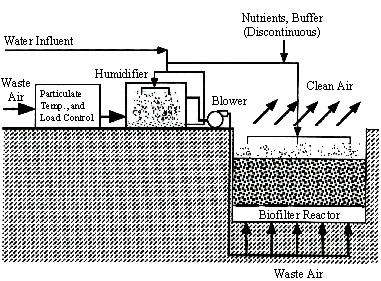
Porous media such as
soil, peat, compost and/or wood chips work well in biofilters for removal of organic
vapors, although they require careful control of temperature and humidity. If the air is
not fully saturated with water vapor, some of the medium may dry out, inactivating the
microbes on it. On the other hand, excessive moisture can cause water to accumulate in the
media, and eventually wash away nutrients.
The weight of moist media limits the depth that can be used without
excessive compression. Worst of all, sulfuric acid formed by biological oxidation of
sulfur compounds can degrade such media, causing them to collapse.
As a result, conventional biofilters using these media often need a
caustic scrubber as a pretreatment stage to humidify the inlet air stream and remove
sulfur compounds.
To eliminate the need for pretreatment of the air or for periodic
replacement of degraded media, biofilters can be built using acid-resistant inorganic
substrates such as porous lava rock. These are referred to as "trickling
biofilters" (or "biotrickling filters") because the media is kept
wetregardless of the humidityby continuous circulation of water.
However, the weight of rock media makes it difficult to handle, and
limits the depth of a filter bed that can be installed without expensive reinforced
structures. The fan power needed to force air through a bed of lava rock is also quite
high. As a result, trickling biofilters using rock media must be sized for very low gas
velocities, resulting in huge footprints.
Nitrifying trickling filters using plastic media have also been used for H2S
odor control,4 but the limited surface area of conventional trickling-filter
media results in relatively low bacterial populations per unit volume. Air residence times
on the order of minutes are required for efficient odor removal. The cost of such enormous
filters cannot be justified unless they are needed to nitrify wastewater.
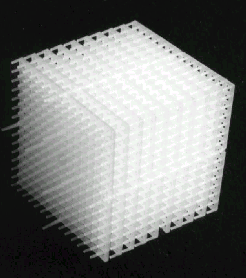
In order to overcome the drawbacks of conventional media, Lantec
Products has developed a high-density polypropylene media known as HD Q-PAC®.
Physical Characteristics
Material:
Polypropylene
Specific Surface Area:
132 ft2/ft3
Drip Points:
75,000/ft3
Bulk Density:
7.5 lb/ft3
Void Fraction:
87.8 %
Smallest Grid Opening:
0.16"´
0.16"
Standard Module Size:
12"´
12"´ 12"
This media is acid-resistant, lightweight, easy to handle, and rigid enough to walk on. It
can be stacked to any desired depth. It provides 132 ft2 of plastic surface per
cubic foot, yet it has a high void fraction, so that even when coated with a layer of
biofilm it still presents much less resistance to air flow than compost or rock media.
This makes it possible to treat air at higher superficial velocities
with reasonable fan power requirements, so trickling biofilters can be made taller rather
than wider, saving valuable space in crowded treatment facilities.
Test Installations
Wastewater Pump Station Odor Control
HD Q-PAC® was used in a small
trickling biofilter as the only odor removal system at a pump house in Saco, Maine. The
pump house is situated in the middle of a residential area, with the closest residence is
no more than 20 feet away. The treatment plant had gotten odor complaints from residents
every summer. A biotrickling filter was installed in May 1999 to evaluate its
effectiveness in reducing high H2S levels during the warm summer months.
Two 55-gallon liquid storage drums with inside diameter of 20 inches
were welded together and used as the biofilter vessel. HD Q-PAC®
was installed in the tower with the needles oriented vertically. Gaps between the media
and the walls of the drums were filled with separated pieces of HD Q-PAC®.
A centrifugal blower rated at 80-100 cfm pushes the air
into the biofilter. Contaminated air enters the bottom of the vessel, passes upward
through the biofilm-coated media, and exits through the top. H2S inlet
concentrations in the pump house air range from 1 to 90 ppmv.
Water is recirculated at 6 gpm. Fresh water with nutrients is added at
1 gpm for 15 min every day. H2S concentrations are
measured using a Scott Alert Meter (Model S108) which is calibrated monthly.
When the biofilter was started up in May 1999, the H2S
removal efficiency increased gradually as biofilm developed on the media, but it remained
below 45%. A commercial lawn-fertilizer dispenser was connected to
the make-up water line to add ammonium phosphate and urea as micronutrients. After
that, the H2S removal efficiency rose to over 90% within a few days. Since
then, the removal has been consistently over 90%, even though the inlet H2S
level varied as much as 400% within the same day.
Throughout the summer of 1999, with recording-breaking high
temperatures, the treatment plant did not receive a single complaint about pump station
odors.
Central Wastewater Treatment Plant
HD Q-PAC® was also tested in a trickling biofilter to
remove hydrogen sulfide from exhaust air at the Hyperion Treatment Plant in Los Angeles,
California.
This test filter has an inside diameter of 4.5 ft and is packed with 7
ft of media. HD Q-PAC® was installed in the tower with its needles oriented
horizontally. Each rectangular module of media was stacked tightly against the others,
leaving no gaps between them. Gaps between the HD Q-PAC® and the walls of the
circular tower were filled in with small pieces of porous rock.
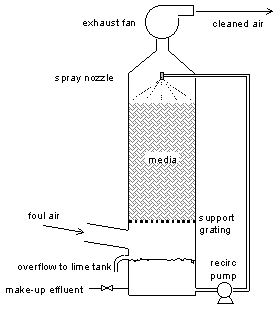
A blower sends untreated air into the bottom of the tricking biofilter.
The air flows upward through the biofilm-coated media, while the water trickles down over
it. The treated air exits the top of the unit.
The filter was initially used to treat 700 cfm of air containing 2-20
ppmv of H2S. Water was recirculated over the media at a rate of 10
gpm.
The unit was started up by filling the 300-gal sump with secondary
effluent from the treatment plant, then running the fan and recirculation pump
continuously until bacteria began to colonize the media, and the pH of the water decreased
to less than 2.0. After that, a portion of the acidic solution was made to overflow every
4 hours by adding secondary effluent at 3 gpm for 20 minutes.
In addition to controlling the pH, the 360 gallons of make-up water
added each day provided micronutrients needed for growth of the biofilm. (Thiobacillus
thiooxidans is autotrophic; it uses atmospheric CO2 as its carbon source.)
The H2S
concentrations in the inlet and outlet air streams were measured daily using an Interscan
Voltammetric Sensor.
The removal efficiency of H2S increased steadily for the
first few days of operation, reaching 90% within 10 days.
Ever since then, the removal efficiency has remained between 90% and
95%, with higher efficiencies recorded occasionally. Since the initial start-up period,
the H2S removal efficiency has never fallen below 90%.5 This is in a
small trickling biofilter with less than 10 seconds of residence time.
Parametric studies aimed at optimizing the operating conditions are
now under way, and will be reported in a future paper. However, the consistent performance
of this test unit over a period of months has demonstrated conclusively that the proper
environment for Thiobacillus growth can be maintained using HD Q-PAC®
and extremely simple equipment.
Possible Applications
The biofilter at Hyperion Treatment Plant using HD Q-PAC® will be scaled up to pretreat large volumes of exhaust air
which is now being processed by conventional wet scrubbers.
Wastewater treatment plants in urban areas are among the worlds largest consumers of
sodium hypochlorite. By removing 90% or more of the H2S using atmospheric
oxygen, the operating cost of chemical oxidants for the scrubbers can be cut by hundreds
of thousands of dollars per year. The existing scrubbers will continue to function as a
"polishing" stage, and as a back-up in case of any problems with the trickling
biofilters.
These biofilters are particularly well suited for odor control at
isolated pumping stations and other facilities where there is no-one to operate a
conventional wet scrubber, even if a water system could afford the equipment and the
chemicals needed to scrub small air streams at many scattered locations. These filters are
simple enough to run automatically without operator attention, and with no need to store
hazardous chemicals at multiple unguarded sites.
In many developing countries, the capital and operating costs of wet
scrubbers are more than treatment plant budgets can bear. The simplicity of trickling
biofilters, and their ability to operate without expensive chemicals, provide a badly
needed alternative in this situation.
Trickling biofilters may also find use as simple pretreatment stages
for conventional biofilters for VOC removal. They can humidify air and greatly reduce its
sulfur content, extending the useful life of water-absorbent biofilter media while
eliminating the need for treatment chemicals.
References
1.Bohn, H., "Soil and compost filters for
malodorous gases," J. Air Pollution Control Assoc.25, p.953 (1975).
2. Ottengraf, S. and Van Den Oever, A., "Kinetics of
organic compound removal from waste gases with a biological filter," Biotechnol.
Bioeng., 25, p. 3089, (1983)
3. Devinny, J., Deshuesses, M., Webster, T.,
"Biofiltration for Air Pollution Control," Lewis Publishers, Boca Raton, p. 74,
(1999).
4. Lutz, M. and Farmer, G., "Pulling double duty: A Colorado
plants trickling filters treat odor while reducing wastewater nitrogen
content," Water Environment Federation Operations Forum, 16 (7),
pp.10-17 (1999)
5. Steve Johnson, Hyperion Wastewater Treatment Plant, Los
Angeles, California (personal communication)
6. Devinny, J., Deshuesses, M., Webster, T.,
"Biofiltration for Air Pollution Control," Lewis Publishers, Boca Raton, p. 9,
(1999).