Newest Articles
ChExpress-June 23, 2009
ChExpress-June 9, 2009
ChExpress-May 26, 2009
ChExpress-May 14, 2009
ChExpress-April 28, 2009
ChExpress-April 14, 2009
ChExpress-March 31, 2009
Electrical Process Tomography
Biodiesel: The Road Ahead
Methanol Plant Capacity Enhancement
Plate and Frame Heat Exchangers: Preliminary Design
Compressor Surging Under Control
Using RPM to Manage Maintenance
Plant and Equipment Wellness, Part 1: Observing Variability


cheplusbannerbig.gif (7470 bytes)

Flow through Orifice Plates in Compressible Fluid Service at High Pressure Drop

Purchase this software title in our online store

More on Fluid Flow from Cheresources.com:
FREE Resources
Article: Centrifugal Pumps - Part I
Article: Centrifugal Pumps - Part II
Questions and Answers: Fluid Dynamics
Experienced-Based Rules for Pumps and Fluid Flow
ChE Links: Search for "Pumps"
Students: Ask a Question in our Forums
Professionals: Ask a Question in our Forums
Purchase / Subscription Resources
Online Store: High Pressure Loss Orifice Calculator
Online Store: Centrifugal Pump Spec Sheet
Online Store: Centrifugal Pumps Tips and Tricks
Online Store: Pump Maintenance Articles
Online Store: Fluid Flow Software

The calculation of compressible flow through orifice plates at high dP (critical flow) appears to be carried out incorrectly in most instances. This flow condition is often encountered
on gas plants, compressor stations and pipelines where orifice plates are commonly used as a cheap and convenient way to regulate blowdown and pressurising rates. Blowdown must be achieved within the time period required to make the plant safe but at the same time without an excessive rate of pressure drop that could damage equipment. A more accurate calculation method is proposed below and should be used to improve the engineering predictions.

Orifice flow calculations typically use the following equations or some variant of them;

high_dp_orifice_flow1.gif (5565 bytes) (Crane Eqn 2-24)


Where 1 indicates upstream conditions, 2 indicates downstream conditions and Ao is the orifice cross section area.

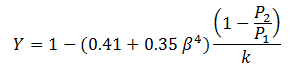
For metering applications the ASME equation is often used to determine the Expansion Factor Y;

high_dp_orifice_flow2.gif (3463 bytes) for flange taps, where P and T are in absolute units.


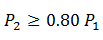
For high accuracy metering (e.g. AGA 3) use of these calculations is often limited to P2 high_dp_orifice_flow7.gif (887 bytes) 0.8 x P1
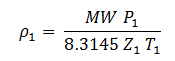
high_dp_orifice_flow3.gif (2177 bytes) where P and T are in absolute units.

It is then often assumed that the orifice flow goes critical (i.e. sonic velocity) at P2 = 0.528 x P1 (for air) and the choked flow equation is then applied;

high_dp_orifice_flow4.gif (3832 bytes) (Crane Pg 2-15), where Pcr = 0.528 x P1

For P2 less than Pcr this method assumes that the flow does not increase further.

Experiments carried out by RG Cunningham and published by ASME in July 1951 clearly demonstrated that the assumption of a fixed limit to critical flow through thin square edged orifice plates is not correct. The flow continued to increase as P2 was reduced below the expected critical condition. Limiting flow was not evident even with P2 as low as 0.1 x P1.

Cunningham’s work included tests with air and steam with the results and conclusions presented as tables, charts and formulas. Limited information is provided for the tests with steam.

The results demonstrated that with suitable corrections to the Expansion Factor Y, the formula for non-critical flow should be used in all cases for thin square edge orifice plates. Critical flow can, however, be expected for thick orifice plates with t high_dp_orifice_flow7.gif (887 bytes) 6 x the orifice diameter.

Cunningham’s paper also includes an equation for the Flow Coefficient, high_dp_orifice_flow5.gif (1882 bytes), though this appears to provide only a rough approximation and other methods may be preferable (e.g. AGA 3).

The ASME formula for Y was shown to be appropriate only down to P2 = 0.63 x P1; (not the normally expected 0.528 from thermodynamic analysis) at which point there is a distinct discontinuity in the flow to lower discharge pressures. Continued use of the ASME formula for Y produces errors of up to 12% if used for lower discharge pressures. Alternative methods reviewed involved errors of up to 40%.

Analysis of the Cunningham data suggests the following formula may be used to determine Y for flange taps at discharge pressures below 0.63 x P1;

high_dp_orifice_flow6.gif (3860 bytes) where Y0.63 is Y from the ASME formula at P2 = 0.63 x P1

The use of a formula similar to the form of the ASME equation is based on an expectation that there is a reasonable probability that the flow to lower pressures will be similarly sensitive to the same geometric and process parameters. The use of ß (beta) to the 4th power provides a reasonable fit to the experimental data. Since the relationship between Y and the pressure ratio is linear the (0.63-P2/P1) component is clearly appropriate. The inclusion of k as a direct divisor in the equation is less obvious and difficult to confirm from the limited data available.

The chart first chart below is extracted directly from the Cunningham report and clearly shows the discontinuity at a pressure ratio of 0.63 and the potential for error if the ASME formula is used beyond this point. The chart second chart below is generated using the proposed method.

high_dp_orifice_flow9.gif (102821 bytes)


high_dp_orifice_flow8.gif (10283 bytes)

The information on the following page demonstrates the derivation of the proposed formula from the published Cunningham experimental results. Plots on the last page show a comparison of some alternative calculation methods. These indicated a good match of the proposed method to that of Perry and another derived from the Grace-Lapple tests, but only for Beta ratios less than 0.6 where significant discontinuities appear with these alternative methods.

For additional charts and graph details, see this Adobe Acrobat Document.

References:   Technical Paper 410M, Crane, 1983
Orifice Meters with Supercritical Compressible Flow, RG Cunningham – ASME, July 1951
Perry’s Chemical Engineering Handbook – 7th Edn – RH Perry, DW Green
Flow Measurement Engineering Handbook, 3rd Edn – RW Miller
(Note: formula 9.58 is correct only for air with ß = 0.15 and could be replaced with the method proposed above.)

Issued: 18th December 2005

By:

Dennis Kirk-Burnnand
Principal Engineer
Dennis Kirk Engineering
41 Woodroyd St, Mt Lawley, Perth, WA  6050         
Ph: +61 8 9272 7198        Mob: +61 0403 270 789
Email: denniskb@ozemail.com.au         Web: www.ozemail.com.au/~denniskb      


ChE Plus Subscriber - Click Here for a Printable Version

Send this Page to a Friend

Fill out your email address to
receive notification of site updates
and instantly receive five technical
questions and answers
!
Email Address:
First Name:
Last Name:

State:

Country:

Industry:

Position:

Signup Remove