|
Hollow Fiber Membranes Abstract Membrane separation processes has become one of the emerging technology which undergo a rapid growth during the past few decades. It has drawn the world attention especially in the separation technology field, one of the chemical Introduction The excellent mass-transfer properties conferred by the hollow fiber configuration soon led to numerous commercial applications in various field such as the medical field (blood fractionation), water reclamation (purification and desalination), gas separation, azeotropic mixture separation (using pervaporation). Others application of this type of membrane are in various stage of development, e.g. and the biochemical industry (bioseparation and bioreactor) and hydrocarbon separation (by pervaporation). Due to the high technology of this advanced materials, Malaysia is urged to focus more in the research of this materials as it has showed its distinguish performance in various field and applications compared to the conventional technique. Historical development of membranes
Table below indicates some of the historical development of the membrane technology before the Golden Age of membrane technology:
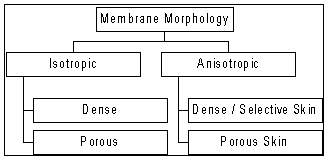
Table 1 Historical development of membranes The golden age of membrane technology (1960-1980) began in 1960 with the invention by Loeb and Sourirajan of the first asymmetric integrally skinned cellulose acetate RO membrane,. This development simulated both commercial and academic interest, first in desalination by reverse osmosis, and then in other membrane application and processes. During this period, significant progress was made in virtually every phase of membrane technology: applications, research tools, membrane formation processes, chemical and physical structures, configurations and packaging. Kesting and Fritzsche describe the significant development of this golden age more detail in their literature (Appendix 1). Basic Morphology Two basic morphology of hollow fiber membrane are isotropic and anisotropic (Fig. 1). Membrane separation is achieved by using of this morphologies.
The anisotropic configuration is of special value. In the early 1960s, the development of anisotropic membranes exhibiting a dense, ultrathin skin on a porous structure provided a momentum to the progress of membrane separation technology. The semipermeability of the porous morphology is based essentially on the spatial cross-section of the permeating species, ie, small molecules exhibit a higher permeability rate through the fiber wall. While the anisotropic morphology of the dense membrane which exhibit the dense skin, is obtained through the solution-diffusion mechanism. The permeation species chemically interacts with thepolymer matrix and selectively dissolves in it, resulting in diffusive mass transport along the chemical potential gradient, as what demonstrated in the pervaporation process. Membrane Configurations Type of the membrane configuration are given in Fig. 2 as below:
Advantages and Disadvantages of Hollow Fiber Hollow fiber is one of the most popular membranes used in industries. It is because of its several beneficial features that make it attractive for those industries. Among them are :
However, it also have some disadvantages which lead to its application constraints. Among the disadvantages are :
Physically and Chemically constraints : Hollow fiber which made of polymer cannot use on corrosive substances and high temperature condition Membrane Processes Various types of membrane processes can be found in almost all of the literature references. In this text, we will confine ourselves to the few membrane processes that we will encounter in the further discussion of the industrial applications. Reverse osmosis (RO) There is considerable confusion in the open literature as to the distinction between few membrane separation processes, i.e., the microfiltration (MF), ultrafiltration (UF) and reverse osmosis (RO). Occasionally one will see it referred to by other names such as "hiperfiltration (HF)". In order to distinguish these separation processes clearly, Porter in his paper presented one of the useful method based on the smallest particles or molecules which can be retrained by the various membranes. Accordingly, RO has the separation range of 0.0001 to 0.001mm (i.e., 1 to 10 Å ) or < 300 mol wt. RO is a liquid-driven membrane process, with the RO membranes are capable of passing water whilst rejecting microsolutes, such as salts or low molecule weight organics (< 1000 daltons). Pressure driving force (1 to 10 MPa) needed to overcome the force of osmosis that cause the water to flow from dilute permeate to concentrated feed. The principle use of this membrane process is desalination, which show its great advantage over the conventional technique of desalination, i.e. ion exchange. Pervaporation (PV) In this process, liquid mixture are fed under pressure to a non-porous membrane, where components pass through the membrane by solution-diffusion and evaporate at the permeate side of the membrane. This technique is able to separate an azeotropic mixture. It current usage is well know in dehydration of the organic solvents and mixtures and the removal of organics from aqueous stream. The future application of this process, which is now under the main interest of the researcher is the hydrocarbon separation,, which shows its advantages of energy require compared to the conventional distillation technique. Gas separation Two type of gas separation processes have been encountered: gas permeation (GP) and gas diffusion (GD). The gas separation of the industrial interest is the former process, which is a pressure driven process where vapor components pass through a non-porous membrane by a solution-diffusion mechanism; analogous to RO. While gas diffusion process can be done for the microporous membranes, operating under a concentration or partial pressure gradient. Industrial Application Membrane processes in chemical & petrochemical industry
Gas membranes are now widely used in variety of application areas, as shown in Table 2. This is because of its advantages in separation, low capital cost, low energy consumption, ease of operation, cost effectiveness even at low gas volumes and good weight and space efficiency.
As the matter of fact, hollow fiber is playing a important role in gas separation. It is because of its high separation areas and selectivity. The hollow fibers have approximately 30 times the productivity of other oxygen enriching membranes plus excellent inertness associated with their totally flourinated chemistry. The market of the gas separation include, small and intermediate scale industrial oxygen and nitrogen at moderate purity levels(oxygen 25%-40% or nitrogrn 82%-95%), portable oxygen for respiratory care, enhanced engine power and emissions reduction and removal gases from liquid. Hollow fibers have demonstrated stable, high flux with moderate selectivity in full scale system. The high flux from hollow fibers is due to the combination of high transfer or separatin areas and thin membrane wall. Besides, it also has a low surface energy. With such characters, hollow fiber is widely used in many gas separation industries. For instance, it is used in O2/N2 separation for oxygen enrichment and inert gas generation, H2 /hydrocarbons separation for refinery hydrogen recovery, H2 /CO separation for sygas ratio adjustment, H2/N2 separation for ammonia purge gas, CO2/hydrocarbons separation for acid gas treatment and landfill gas upgrading, H2O/hydrocarbons separation for natural gas dehydration, H2S/hydrocarbons separation for sour gas treating, helium separation and etc.(refer Table 3)
Apart from that, low capital cost of hollow fiber also lead to its popularity. For example, for oxoalcohol feed separation, the process cost is about 1.000 for hollow fiber membrane. However, for crygenic(partial condensation) and PSA processes are about 1.234 and 1.133 respectively.(appen ) From here, we can see that most of the cost for hollow fiber is for compression and not for purification. It is because hollow fiber itself already provides a good medium for purification.
As mentioned in the above section, RO is mainly use to remove the dissolved ion in the feed water. Its current extensive use in Malaysia industry sector is found in the production of ultrapure water in the semiconductor manufacturing industry. Historically, distillation and ion exchange was first used to remove the inorganic salts, but RO membrane processes with the combination of ion-exchange system has promised a better result in both the product requirement and a better economic view point. Other usage of RO included the removal of organics, salts and silica ahead of deionizers in boiler feed water, removal of inorganic salts, phosphorus and nitrogen compound in the municipal waste water treatment and also the demineralization of sea water and brackish water in the production of potable water. Porter provide a good reference in the comparison of product quality and economic of the above processes. Membrane processes in biotechnology and biochemical industry The biotechnology industry, which originated in the late 1970s, has become one of the emerging industry that draws the attention of the world, especially with the emergence of the genetic engineering as a means of producing medically important proteins, during the 1980s. Two of the major interest applications of membrane technology in the biotechnology industry will be the separation & purification of the biochemical product, as often known as Downstream Processing; and the membrane bioreactor, which developed for the transformation of certain substrates by enzymes (i.e. biological catalysts). Lots of literature has been published since the last ten years for these topic which serve as a good reference is sited in the Reference.
"Downstream Processing", a new key term given a decades ago, devotes towards the science and engineering principles in separation and purification in this emerging industry, has become a key issue to enhance the quality of the biochemical product. It is particularly important because it typically accounts for nearly three-fourths of the manufacturing costs in this new industry and because reliable and effective purification can be of the utmost important to the user. Membrane separation, together with the bioaffinity chromatography, liquid extraction and selective precipitation are the few techniques in the bio-separations, which gain attention from both the industries and researcher in order to upgrade the product quality of the biochemical industry. Lots of study has been put in this area involving the most of the recovery of the biofuels and the biochemicals. Throughout the available literature, the most useful review is presented by Stephen A Leeper (1992), which compiles a large number of the previous and current studies' data on the different types of biofuels and the biochemicals product recovery, consisting of the usage of different types of membrane materials, membrane processes, together with the operating parameters of the studies being carried out.
Since its introduction in the 1970s, membrane bioreactor has granted a lot of attention over the other conventional production processes is the possibility of a high enzyme density and hence high space-time yields. Whereas downstream processing is usually based on discontinuously operated microfiltration, membrane bioreactor are operated continuously and are equipped with UF membranes. Two type of bioreactor designs are possible: dissolved enzymes, (as in used with the production of L-alanine from pyrurate) or immobilized enzymes membrane. Future Prospects Membrane science began emerging as an independent technology only in the mid-1070s, and its engineering concepts still are being defined. Many developments that initially evolved from government-sponsored fundamental studies are now successfully gaining the interest of the industries as membrane separation has emerged as a feasible technology. As were noted by the US National Research Council, the technological frontiers of the membrane technology should be concerned more in the developing of new membrane materials and the identification of new ways of using permselective membranes. New membrane materials to be used is still a big option in the research of this brand new technology, as most of the researchers are always intend to get a better improvement for this separation process. Journal of Membrane Science serve as a good reference, where lots of the new membrane materials research may be found. For the latter, membrane-based hybrid system serve as a good example, as it is a combination of conventional unit operations and membrane separation processes, which often results in separation processes that offer significant advantages over the exclusive use of either component process. Such advantages may include more complete separation, reduced energy requirement, lower capital cost, and lower production cost. Two good example of this hybrid system are the RO / evaporator hybrid system to concentrate corn steep water, and a membrane / vapor-recompression hybrid process to recover energy in hot, moist dryer exhaust. Studies has also been carried out and proven that these hybrid system did perform a better of the washwater purification and reuse pilot plant (HUMEF) which has been successful installed in Eindhoven pumping station, the Netherlands.
General Reference
Internet reference **This article was graciously submitted to www.cheresources.com for publication by Foo Chwan Yee from Malaysia. The author can be reached for questions/comments at cyfoo98@pd.jaring.my
|
ChE Plus Subscriber - Click Here for a Printable Version