banner2.gif (6526 bytes)

Packed Column Design

More on Packed Towers from Cheresources.com:
FREE Resources
Article: Sizing of Packed Towers in Acid Plants
Article: Distillation Pilot Plant Design
Experienced-Based Rules for Packed Towers
ChE Links: Search for "Packed Columns"
Students: Ask a Question in our Forums
Professionals: Ask a Question in our Forums
Purchase / Subscription Resources
Book: Applied Process Design Volume II
Premium Content: Packed Tower Design Spreadsheet
Online Store: Tower Internals Specification Sheet

     Designing a randomly packed column is a subtle blend of art and science.  Packed columns are most frequently used to remove
contaminants from a gas stream (absorption).  However, packed columns can also be used to remove volatile components from a liquid stream by contacting it with an inert gas (stripping).  They are also used in distillation applications where the separation is particularly difficult due to close boiling components.  While we'll discuss all of these applications, we'll focus on absorption.  However, the design methods are similar for any of the scenarios.
packcol4.gif (5368 bytes)     The first step in designing a packed tower is more science than art.  The equilibrium data between the contaminant and the solvent (or the distillation components) is needed for the analysis.  If tabulated data for your system is unavailable and the total amount of the contaminant is small (as it usually will be), Raoult's Law can be used to estimate the equilibrium data for absorption or stripping applications.  For distillation, equilibrium data can be predicted by selecting the appropriate thermodynamic model (see Choosing a Thermodynamic Model for Use in Simulation).  The operating line for the tower is constructed differently depending on whether you're dealing with distillation or absorption/stripping.  Since we're focusing on absorption, we'll use it as an example.  In absorption/stripping, the operating line is constructed differently depending on whether the contaminated stream can be considered "dilute" or if it must be treated as a concentrated stream.   Usually, it is safe to treat the stream as dilute if the contaminant makes up less than 10 mole percent of the stream.  For streams that cannot be considered dilute, the mass transfer coefficients must be evaluated in terms of the gas and liquid flows.   Then, graphical evaluation of several integral relationships must be completed.   This type of evaluation is outside the scope of this article and a text should be consulted for solving these types of problems.  For this article, we will consider dilute streams which are more common for packed tower absorption and stripping.
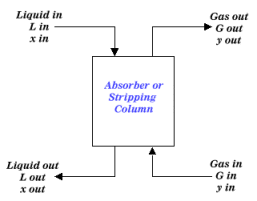
     Dilute streams allow the column designer to assume constant mass transfer and the operating line can be constructed in terms of the simplified balance shown below:

L out  x out  + G out  y out = L in  x in  + G in   y in

This relation is used in the following manner:

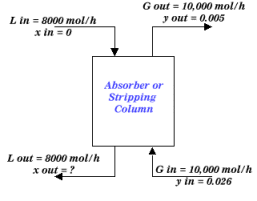
Suppose you wish to remove acetone from a gas stream of 10,000 mol/h in a packed column.  The inlet gas contains 2.6 mole percent acetone and the outlet gas stream can contain no more than 0.5 mole percent acetone.  Assume a pure water stream enters the packed tower at a rate of 8,000 mol/h.
packcol5.gif (6336 bytes)L out x out + G out y out = L in x in + G in y in
(8000) x out + (10000)(0.005) = (8000)(0)+(10000)(0.026)

x out = 0.02625


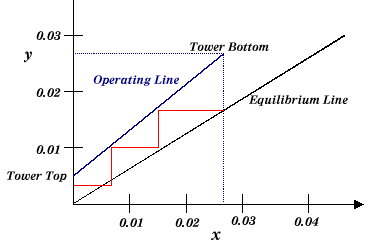
The equilibrium and operating lines are constructed as follows:

packcol6.gif (5481 bytes)Just as in the McCabe-Thiele analysis of distillation, the equilibrium stages are stepped off between the two lines.  Note that for stripping, the operating line would be on the other side of the equilibrium line.
     Once the theoretical number of stages have been determined, you can proceed with the design of the column by following the three steps that we'll outline below.
 

To best illustrate the other steps in the process, we'll use the following example:

Specify the packing type and column dimensions for a column that will be used to remove chlorine from a gas stream using an organic solvent.  Assume the separation requires 20 theoretical stages.  The vapor flow is 7000 kg/h, the average vapor density is 4.8 kg/m3.  The liquid flow is 5000 kg/h, the average liquid density is 833 kg/m3.  The liquid's kinematic viscosity is 0.48 centistokes (4.8 x 10⁻⁷ m2/s)

STEP 1:  SELECTING A TYPE AND SIZE OF PACKING
     This is where the art of designing packed columns begins.   Some people believe that there are stringent rules surrounding the choice between random and structured packing.  You can think of random packing as the type that comes in a sack and it is simply dumped into the column.  Structured packing may come in bales or intricate designs that are stacked in specific patterns.  This is probably one of those areas of engineering where past experience in the application is the best guide.  Two "areas of choice" where structured packing is used are in very low pressure drop applications and for increasing the capacity of an existing column.   Since we're considering a new design with no serious pressure drop constraint, we'll choose the more economical random packing.
     Below are charts showing both English and Metric unit packing factors.  The most common random packing types are shown here:

packcol2.gif (17436 bytes)
packcol3.gif (17768 bytes)

     Generally, the column diameter to packing size ratio should be greater than 30 for Raschig rings, 15 for ceramic saddles, and 10 for rings or plastic saddles.  The geometry of your packing will typically be a function of the needed surface area and/or allowable pressure drop.  If several packings meet your requirements, you'll typically choose the least expensive so long as it has an acceptable operating life.  For our example, we'll choose Pall rings (plastic).   For columns over 24 inches in diameter, No. 2 or 2 inch packing should be examined first.  By looking at our flowrates, the chances of our column having a diameter of at least 24 inches are good, but we'll verify this later.  For now, we'll settle on 2 inch plastic Pall rings for our initial analysis.

STEP 2: DETERMINE THE COLUMN DIAMETER
     Most methods for determining the size of randomly packed towers are derived from the Sherwood correlation.  A design gas rate, G, can be determined with the help of the figure below which is based on correlation from the Sherwood equation (printable version here):

packcol1.gif (133678 bytes)

     Each line on the graph is marked with an acceptable pressure drop in inches of water per foot of packing (numbers in parentheses are in mm of water per meter of packing).  Guidelines are as follows:

  • Moderate to high pressure distillation = 0.4 to 0.75 in water / ft packing
                                                            = 32 to 63 mm water / m packing

  • Vacuum Distillation = 0.1 to 0.2 in water / ft packing
                                  = 8 to 16 mm water / m packing

  • Absorbers and Strippers = 0.2 to 0.6 in water / ft packing
                                          = 16 to 48 mm water / m packing

These guidelines are designed around "flooding pressure drops" documented in literature.  In other words, for most cases, designing with these pressure drops should help you avoid flooding.  In the later stages of design, you may want to perform a thorough flooding calculation.  Perry's Chemical Engineers' Handbook covers this topic well.  Since we are designing an absorber, we will design for 42 mm water / m packing (you could design for a lower pressure drop, but the column will increase in diameter and most likely cost).  First, we'll evaluate the x-axis of the graph above:
(L/V)(vapor density/liquid density)0.5 = (5000/7000)(4.2/833)0.5 = 0.0507
Note that 4.2 kg/m3 was used for the vapor density.  The average vapor density was given as 4.8 kg/m3.  However, at the top of the column, the vapor will be less dense and at it's highest velocity.  This is what you should design for.  As a rule of thumb, I reduce the average vapor density by about 15% for design, however if you can get real data from a similar tower, certainly do so!   Reading the intersection of the 42 mm water/m packing line and 0.05 on the axis, we find a value of 1.5 for the y-axis:

packcol7.gif (64653 bytes)

From the previous charts, we read a packing factor of 24 for 2 inch plastic Pall rings.  All other information is know so we can solve for G as shown on the y-axis of the graph:

G = [1.5 [(4.2)(833-4.2)]/[(10.764)(24)(0.48)0.1]]0.5 = 4.66 kg/m2 s

Now, we solve for the column cross sectional area:

Ax = Vapor Flow / G = 7000 kg/h / [(4.66 kg/m2 s)(3600 s/hour)] = 0.42 m2

and the column diameter is calculated by:

Diameter = [Ax / (PI/4)]0.5 = [0.42/(PI/4)]0.5 = 0.73 m or 2.4 ft

So our assumption of at least a 24 in column diameter is accurate.   If it had not been accurate, G would be recalculated using a smaller packing which would also correspond to a larger packing factor.

STEP 3: DETERMINE THE COLUMN HEIGHT
     Perhaps the most interesting step in designing a packed column is deciding how tall to build it.  You should first ask yourself "What stage of the design are we currently working on?"  If the design is preliminary, the general HETP (Height Equivalent to a Theoretical Plate) will work well.  If the design requires a higher degree of accuracy, I recommend consulting the packing manufacturer or a book entitled Distillation Design by Henry Kister (McGraw-Hill, ISBN 0-07-034909-6).  Distillation Design contains an exhaustive list of HETP values based on the components of the system and the type of packing used (Chapters 10 and 11).  As for preliminary estimates, the following HETP values should be used:

SETUP HETP expressed as ft (meters)
Method Packing Size (in)
Distillation 1.0 1.5 (0.46)
1.5 2.2 (0.67)
2.0 3.0 (0.91)
Vacuum Distillation 1.0 2.0 (0.67)
1.5 2.7 (0.82)
2.0 3.5 (1.06)
Absorption/Stripping All Sizes 6.0 (1.83)

To determine the height of the absorption tower in our example, we multiple the 20 theoretical stages by 6 ft or 1.83 m.  We estimate the height of the tower to be 120 ft or about 37 meters.

OTHER NOTES:
     While our example problem focused on absorption, packed towers are also widely used in distillation.  Perhaps the most popular of which is the well documented vacuum distillation of ethylbenzene and styrene in the Production of StyreneDistillation Design covers this application very well.  If you're seeking a qualified packing manufacturer to consult with, go to Norton's Mass Transfer page.  They're very well respected in this field and their experience is unmatched.  You can also see pictures of some of the packings on their website.


ChE Plus Subscriber - Click Here for a Printable Version

Send this Page to a Friend

Fill out your email address to
receive notification of site updates
and instantly receive five technical
questions and answers
!
Email Address:
First Name:
Last Name:

State:

Country:

Industry:

Position:

Signup Remove