storead.gif (11277 bytes)
Download Separation Software Instantly

Pervaporation: An Overview
Download a Printable Version Here (Adobe Acrobat Format)

Pervaporation, in its simplest form, is an energy efficient combination of membrane permeation and evaporation.   It's considered an attractive alternative to other separation methods for a variety of processes.  For example, with the low temperatures and pressures involved in pervaporation, it often has cost and performance advantages for the separation of constant-boiling azeotropes.  Pervaporation is also used for the dehydration of organic solvents and the removal of organics from aqueous streams.  Additionally, pervaporation has emerged as a good choice for separation heat sensitive products.

pervaporation1.gif (6419 bytes)

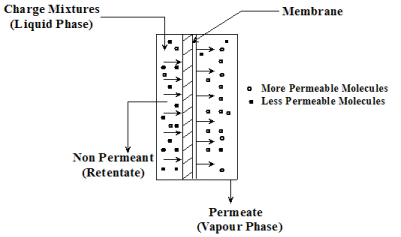
Pervaporation involves the separation of two or more components across a membrane by differing rates of diffusion through a thin polymer and an evaporative phase change comparable to a simple flash step.  A concentrate and vapor pressure gradient is used to allow one component to preferentially permeate across the membrane.  A vacuum applied to the permeate side is coupled with the immediate condensation of the permeated vapors.  Pervaporation is typically suited to separating a minor component of a liquid mixture, thus high selectivity through the membrane is essential.  Figure 1 shows an overview of the pervaporation process.

Pervaporation can used for breaking azeotropes, dehydration of solvents and other volatile organics, organic/organic separations such as ethanol or methanol removal, and wastewater purification.

Characteristics of the pervaporation process include:
pervaporation2.gif (12911 bytes)
  1. Low energy consumption

  2. No entrainer required, no contamination

  3. Permeate must be volatile at operating conditions

  4. Functions independent of vapor/liquid equilibrium

Types of Pervaporation Process

Batch pervaporation is a simple system with great flexibility, however a buffer tank is required for batch operation.  Continuous pervaporation consumes very little energy, operates best with low impurities in the feed, and is best for larger capacities.   Vapor phase permeation is preferred for direct feeds from distillation columns or for streams with dissolved solids.

Pervaporation for Separation

Liquid transport in pervaporation is described by various solution-diffusion models1.   The steps included are the sorption of the permeate at the interface of the
solution feed and the membrane, diffusion across the membrane due to concentration gradients (rate determining steps), and finally desorption into a vapor phase at the permeate side of the membrane.  The first two steps are primarily responsible for the permselectivity1.  As material passes through the membrane a "swelling" effect makes the membrane more permeable, but less selective, until a point of unacceptable selectivity is reached and the membrane must be regenerated. 

The other driving force for separation is the difference in partial pressures across the membrane.  By reducing the pressure on the permeate side of the membrane, a driving force is created.  Another method of inducing a partial pressure gradient is to sweep an inert gas over the permeate side of the membrane.  These methods are described as vacuum and sweep gas pervaporation respectively.

Basics of the Pervaporation System

pervaporation16.gif (18687 bytes)

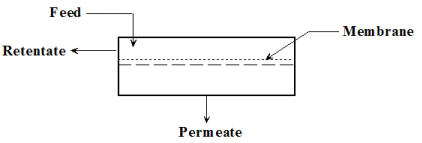
Figure 3 shows a typical pervaporation system.  The feed is allowed to flow along one side of the membrane and a fraction of the feed (permeate) passes through the membrane and leaves in the vapor phase on the opposite side of the membrane.   The "vapor phase" side of the membrane is either kept under a vacuum or it is purged with a stream of inert carrier gas.  The permeate is finally collected in the liquid state after condensation.  The liquid product is rich in the more rapidly permeating component of feed mixture.  The retentate is made up of the feed materials that cannot pass through the membrane. 

Membranes

The membranes used in pervaporation processes are classified according to the nature of the separation being performed.  Hydrophilic membranes are used to remove water from organic solutions.  These types of membranes are typical made of polymers with glass transition temperatures above room temperatures.  Polyvinyl alcohol is an example of a hydrophilic membrane material.  Organophilic membranes are used to recover organics from solutions.  These membranes are typically made up of elastomer materials (polymers with glass transition temperatures below room temperature).   The flexible nature of these polymers make them ideal for allowing organic to pass through.  Examples include nitrile, butadiene rubber, and styrene butadiene rubber.

Factors Affecting Membrane Performance

According to the solution-diffusion model, higher fluxes can be obtained with an increased thermal motion of the polymer chains and the diffusing species.  Properties of the polymers that affect diffusion include the "backbone" material, degree of cross-linking, and porosity.  Molecular-level interactions between membranes and diffusing species is expressed via a permeability constant used in the Arrhenius relationship:

pervaporation3.gif (1195 bytes) (1)


Where,
Ep = Activation energy
Po = Permeability constant
R  = Gas constant
T  = Temperature

Pervaporation Characteristics

1.  Molecular Flux

Molecular flux is the amount of a component permeated per unit area per unit time for a given membrane.

pervaporation4.gif (1215 bytes) (2)


Where,
Ji = Flux of component "i" (moles/h cm2)
Qi = Moles of component "i" permeated in time "t"
A = Effective membrane surface area (cm2)

2.  Permselectivity

The performance of a given membrane can be expressed in terms of a parameter called permselectivity:

pervaporation5.gif (1476 bytes) (3)
pervaporation6.gif (1748 bytes) (4)


Assuming the density of the components in the feed is the same, then:

pervaporation7.gif (1480 bytes) (5)


Where,
X = Weight fraction
V = Volume fraction
p = Density
Superscripts "p" and "f" denote "permeate" and "feed" respectively while "i" and "j" represent individual components.

3.  Permeability Coefficient

The molecular flux for pervaporation across a membrane can be related to the permeability coefficient by:

pervaporation8.gif (1102 bytes) (6)


or

pervaporation9.gif (1079 bytes) (7)


Here, pervaporation10.gif (1086 bytes)and pervaporation11.gif (1447 bytes), therefore

pervaporation12.gif (1352 bytes) (8)


Equation 6 becomes,

pervaporation13.gif (1445 bytes) (9)


pervaporation14.gif (1482 bytes) (10)


pervaporation15.gif (7976 bytes)

Industrial Applications

Established industrial applications of pervaporation include:
The treatment of wastewater contaminated with organics4
Pollution control applications4
Recovery of valuable organic compounds from process side streams5
Separation of 99.5% pure ethanol-water solutions6
Harvesting of organic substances from fermented broth7

Other products separated or purified by pervaporation include:

Alcohols Ketones
Methanol Acetone
Ethanol Butanone
Propanol (both isomers) Methyl isobutyl ketone (MIBK)
Butanol (all isomers) Amines
Pentanol (all isomers) Triethylamine
Cyclohexanol Pyridine
Benzyl alcohol Aniline
Aromatics Aliphatics
Benzene Chlorinated hydrocarbons (various)
Toluene Dichloro methane
Phenol Perchloroethylene
Ester Ethers
Methyl acetate Methyl tert-butyl ether (MTBE)
Ethyl acetate Ethyl tert-butyl ether (ETBE)
Butyl acetate Di-isopropyl ether (DIPE)
Organic Acid Tetrahydro furan (THF)
Acetic acid Dioxane

Continuing Research on Pervaporation

Pervaporation of Apple Juice

Pervaporation is used to recover any lost juice solution during evaporation.  The vapor from the evaporation process is further processed using pervaporation.  The recovered, concentrated apple juice can be combined with the product solution to help the apple juice retain it's aromatic and taste qualities.

Pervaporation in the Production of Fuel Ethanol

To establish a continuous fermentation process, the ethanol concentration within the fermentation vessel must be kept at 5% by weight or lower.  Pervaporation has been used to maintain the necessary ethanol concentration in the broth.  The advantages of using pervaporation in such a system include the ease of processing the clean, nearly pure ethanol extracted from the fermentation vessel and a significantly higher fermentation capacity or the reduction in fermentor size and costs.

Summary

Pervaporation continues to evolve as a feasible separation technology for many different applications.  As a proven method of separation as low temperatures and pressure, further application development for food processing is likely.  Using pervaporation to clean wastewater streams by removing a variety of organic compounds also holds much promise. 

References

1.    Yong Soo Kang, Sang Wook Lee, Un Young Kim and Jyong sup shim, Pervaporation of water – Ethanol mixtures through
       cross – linked and surface modified poly (vinyl alcohol) membrane, J. Member. Sc., Elsevier Science Publishers B.V., Amsterdam,          51, 215, 1990.
2.    K.W. Boddeker and G. Bengston, Pervaporation membranes separation processes, Ed. By R.Y M. Hang. Elsevier, Amsterdam          437 – 460, 1991.
3.    G.H. Koops and C.A. Smolders Pervaporation membrane separation process, Ed. by R.Y.M Haung, Elsevier, Amsterdam 249 –          273, 1991.
4.    C. Lipski and P. cote, the use of Pervaporation for removal of organic containment from water, Environmental program, 9, 254 –          261, 1990.
5.    J. Kashemekat, J.G. Wiljmans and R.W Baker, Removal of organic solvent containments from industrial effluent streams by          
       Pervaporation, Ed. By R. Bakish, Proc. 4th int. Conf. On Pervaporation, process in chemical industry, Bakish materials    
       Corporation, Englewood, NJ, 321, 1981.
6.    B.K. Dutta and S.K Sridhar, separation of azeotropic organic liquid mixtures by Pervaporation, AIChE journal, vol.37, No.4, 581          – 588, 1991.
7.    M.E.F. Garcia, A.C. Habert, R. Nobrega and L.A. Piers, Use of PDMS and EVA membranes to remove ethanol during      
       fermentation, Ed, by R. Bakish Proc. 5th Int. Conf. on Pervaporation process in the chemical industry, Bakish Materials      
       corporation, Englewood, NJ, 319 – 330, 1991.
8.    Aptel, P., N. Challard, J. Cuny, and J. Neel, “ Application of the Pervaporation Process to Separate Azeotropic Mixtures,” J.   
       Membrane Science., 1, 271 (1976).
9.    Dutta, B.K., D. Randolph, and S.K. Sikdar, “ Separation of Amino Acids Using Composite Ion Exchange Membranes,”   
       Biochemical Engineering VI, new York Academy of science, 589, 203,1990

By: Mahesh Kumar S, Guest Author
s_mib19@yahoo.com


ChE Plus Subscriber - Click Here for a Printable Version

Send this Page to a Friend

Fill out your email address to
receive notification of site updates
and instantly receive five technical
questions and answers
!
Email Address:
First Name:
Last Name:

State:

Country:

Industry:

Position:

Signup Remove