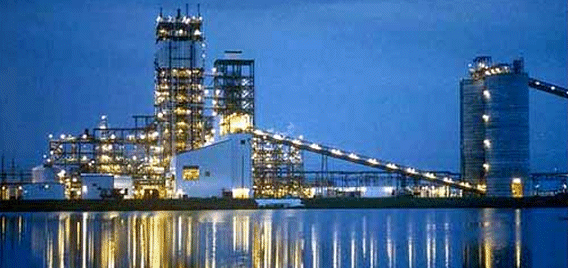
Steam reforming of hydrocarbons for ammonia production was introduced in 1930.
Since then, the technology has experienced revolutionary changes in its energy
consumption patterns. Ranging from an early level of 20 Gcal/tonne (79.4 MBtu/tonne)
to about 7 Gcal/tonne (27.8 MBtu/tonne) in the last decade of the 20th century. The
energy intensive nature of the process is the key driving force for improving the
technology and reducing the overall cost of manufacturing.
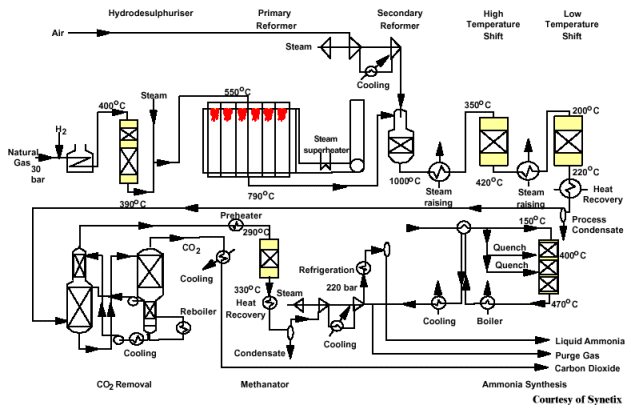
Figure 1: Overall Layout of a Steam Reforming Plant for Ammonia
Synthesis
Looking further ahead, we'll
review some potentially significant developments and concepts that may impact the manner
in which ammonia is produced. Some of these manufacturing routes are being tested or
employed at a few plants around the world, but have yet to be fully developed into
commercial processes. We'll also review more traditional approaches to ammonia
manufacturing along the way.
Developments
1. Reforming Section
In the conventional process, steam reforming is carried out
in a fired furnace of the side fired or top fired type. Both need large surface
areas for uniform heat distribution along the length of the catalyst tubes. This
process has several disadvantages. For example, it is a thermally inefficient
process (about 90% including the convection zone) and there are mechanical and maintenance
issues. The process is difficult to control and reforming plants require a large
capital investment.
A. Gas Heated Reformers
Future technologiesinclude the use of Gas Heated Reformers (GHR), which are
tubular gas-gas exchangers. In the GHR, the secondary reformer outlet gases supply
the reforming heat. Though it is not presently being used widely, GHR has certain
advantages over fired furnaces. Table 1 shows a list of these advantages.
Kellogg's Reforming Exchanger System is an example of GHR technology. Although GHR
results in reduced energy consumption, a comprehensive energy conservation network should
be established to maximize the benefits of a GHR system.
Table 1: Advantages of Gas Heated Reformers
Fired Furnace
Gas Heated Reformers
Large volumes
Smaller volumes
Larger surface area and heat loss
Reduced surface area and heat loss
Complex instrumentation
Simplified instrumentation
High maintenance costs
Low maintenance costs
Large convection zone
No convection zone
Stack losses
No stack losses
High fixed capital costs
Low fixed capital costs
Reduced catalyst tube loss from high temperature and uneven heat
distribution
Longer tube life due to uniform heat distribution
Increased downtime required for shut down
Reduced downtime required for shut down
Well established process
Yet to gain wide acceptance
B. Hydrogen Separation
Lechatelier's Principle states that a reaction equilibrium
can be shifted by applying external forces. This offers a means of removing products
from the reaction mixture to increase the conversion per pass. In reforming,
experiments have been performed up to 500 0C (932 0F) and 20 bar
(294 psig) using a palladium membrane to remove the product hydrogen. These
experiments have results in a significant increase in methane conversion as can be seen by
the following case study.
Case Study on the Membrane Separation Process
The separation of hydrogen from the product gas
of the reforming process can result in significant productivity gains when compared to the
current processes being employed. The base case for this study is a conventional
steam reforming plant based on natural gas operating at 1750 tonnes per day. The
operating conditions of the plant are assumed to be the same as those typically employed
today and the only modification is the introduction of hydrogen separation. The
tests for the membrane separation have been carried out at 500 0C (932 0F)
and 20 bar (294 psig), these conditions will function as upper limits for the process to
be considered in this study. Membrane units will be considered after the primary
reformer (at 60% hydrogen separation), after the secondary reformer (at 60% hydrogen
separation), and after the High Temperature Shift (HTS) converters (at a 50% hydrogen
separation)
The following assumptions are made in this case
study:
The natural gas feed at the primary reformer is the same for both cases.
The primary reformer exit temperature is the same for both units.
The primary reformer operating pressure is the same for both units.
The process air is fed to the secondary reformer at optimal conditions and any remaining
nitrogen that is required is supplied through an Air Separation Unit (ASU) and is
available at 0.1 kg/cm2 (1.42 psig)
Any extra energy consumption in the ASU is considered for the revamp case.
All of the heat from the process gas from the primary reformer to the carbon dioxide
removal section is used in a steam network.
No changes in the carbon dioxide removal system are considered.
The pressure drop across the front end of the process is kept constant for both systems,
thus the synthesis gas compressor suction pressure remains constant.
The loop pressure is the same for both processes and is controlled by changing the purge
gas quantity.
The existing compressors are capable of handling any additional loads.
No scheme changes are considered in the synthesis loop.
All hydrogen from the membrane separation unit is available at 9.0 kg/cm2
(128 psig)
The productivity analysis is carried out on the ammonia plant only (the urea plant is
excluded)
A complete steam balance is included on both processes. Changes in the steam
balance are considered for:
Steam generation from the front end of the processes
Steam generation from the back end of the processes
Additional steam in the carbon dioxide removal section caused by a reduction in the heat
available from the process gas
Additional power for the synthesis compressor due to changes in flow and composition
Additional power in the ammonia refrigeration compressor
Reduced load on the process air compressor
Additional power for low pressure hydrogen separated through membranes
Additional power for nitrogen compression
Additional power for the air compressors of the ASU
Small changes in other drives and small equipment
Comparison Between Conventional Reforming and Reforming with
Hydrogen Separation
Production rise from 1750 to 1854 tonnes per day
+6.0% rise in capacity
Process Change
Energy Change (Gcal/tonne)
Gain in feed and fuel including steam superheater
+0.36
Loss in steam generation (front end)
0.00
Loss in steam generation (back end)
-0.02
Loss in additional steam for carbon dioxide removal
-0.27
Gain in energy in synthesis gas compressor
+0.01
Extra energy in refrigeration compressor
0.00
Gain in energy in process air compressor
+0.16
Extra power in hydrogen compressor
-0.22
Extra power for nitrogen from ASU
-0.12
Steam savings in primary reformer
+0.08
Other rotary drives and equipment
+0.04
Total Gain
+0.02
It is evident from these results that the major losses occur in the carbon dioxide
removal section of the plant. These losses are the result of consuming additional
steam and compression energy for hydrogen separation. With additional minimization
of these losses, additional savings can result. For a production gain of 6%
over the base case, the energy saving is 0.02 Gcal/tonne (0.08 MBtu/tonne).
This development could yield savings by increasing methane conversion in
reformers and increasing the carbon monoxide conversion in shift reactors. The
energy savings can be as high as 0.50 Gcal/tonne (1.98 MBtu/tonne) depending on the
adopted process configuration. Hydrogen separation technology can also result in
increased ammonia plant capacity as illustrated in the above case study.
The reduced air requirement (about 80% of conventional plants) in the
secondary reformer is required with a 60% hydrogen removal rate in the reformer.
This will also require an additional source of nitrogen. Therefore, the technologies
in which nitrogen is being added separately, either from an Air Separation Unit (ASU) or
from any other sources, will become more important in this case.
C. Isobaric Manufacturing
The primary hurdle in the isobaric method of manufacturing ammonia is the
poor conversion of methane at elevated pressure. The bottleneck is the maximum
permissible temperature range due to metallurgical constraints in the reformer tubes.
Synthesis pressures are no longer an issue with the development of the Kellogg Advanced Ammonia Process (KAAP), which utilizes a
ruthenium-based catalyst operating at 90-100 ata (1470 psia). Thus, if the methane
conversion can be increased by hydrogen separation, the process can be operated at higher
isobaric pressures.
The synthesis compressor can be
reduced to one small compressor at the natural gas feed. The power consumption in this
compressor will be 3.0 MW for an isobaric pressure of 100 ata in the front end because of
reduced gas flow and reduced differential pressure. The gas flow in synthesis
compressor remains near 200,000 Nm3/h (117,715 scfm) while the flow will be
reduced to near 45,000 Nm3/h (26,485 scfm) in natural gas compressor. The
differential pressure in the synthesis compressor is 175 kg/cm2a (from 25 kg/cm2g
to 200 kg/cm2g), while the differential pressure is only 60 kg/cm2a
in natural gas compressor (from 40 kg/cm2g to 100 kg/cm2g).
The power consumption is around 3.0 MW in the conventional recirculator. This will
result in a total power consumption of 6.0 MW in raising the pressure of synthesis gas.
Presently, the power consumption in the synthesis gas compressor is around 25.0 MW for a
conventional ammonia plant at same load. This ,however, requires the process air
compressor to be operated at a discharge pressure of 100 ata (1470 psia) compared with a
pressure of 34-35 ata (510 psia) in the conventional plant. The net energy saving in
the isobaric process can be near 0.5 Gcal/tonne (1.98 MBtu/tonne). Moreover,
it will also save the energy in CO2 compressor of the urea plant because the CO2
from the ammonia plant will be available at a much higher pressure.
2. Shift Section
The water-gas shift reaction is favorable for producing carbon dioxide
which is used as a raw material for urea production. Presently, most plants use a
combination of conventional High/Low Temperature Shift (HTS/LTS) or High/Medium/Low
Temperature Shift (HTS/MTS/LTS) technology. Another option is a combination of
HTS/LTS/Selectoxo technology. While not as common as the other combinations, this
arrangment offers advantages that will be discussed later. The most important
objectives for this section are a low pressure drop and efficient heat recovery from the
process gas.
A. Selectoxo Unit
The Selectoxo unit offers several advantages for grass root designs as
well as for revamps. Selectoxo (or selective catalytic oxidation) was developed by
Engelhard for oxidizing carbon monoxide while not oxidizing hydrogen. The Selectoxo
process provides good energy efficiency because it minimizes carbon moxide
"slip" (only about 0.03%), improved process flexibility, and higher productivity
in revamps when compared to other oxidation options. The Selectoxo unit is capable
of increasing a plant's capacity by 1.5-2.0%.
The Selectoxo unit can also help in a grass root plant by maintaining
carbon dioxide/ammonia production ratios which is favorable for full conversion of ammonia
to urea. The economics of this option are to be considered against the extra cost of
carbon dioxide production by other means (either from the flue gas of the primary reformer
or through back burning of extra synthesis gas).
3. Carbon Dioxide Removal Section
The removal of carbon dioxide has been performed via solvent absorption
and distillation since the inception of ammonia technology processes. This section
of the ammonia plant is the largest consumer of energy after the cooling water system.
The energy consumption is due to thermally inefficient distillation, dissipation of
huge amounts of low level heat into the cooling water via product carbon dioxide, and
pressurization and depressurization of absorbents.
A. Isobaric Manufacturing
Chemical absorption in the isobaric manufacturing of ammonia can be
unattractive because of the very high pressure (100 ata). Therefore, major changes
in the existing carbon dioxide removal technologies may be necessary. Replacement
technologies may include cryogenic condensation or pressure swing absorption (PSA).
Carbon dioxide separation through PSA is offered in the Low Cost Ammonia
Process (LCA). PSA is scalable an may be more economical because of efficient carbon
dioxide recovery at higher pressures. However, further development in this direction
is essential for the recovery of high purity carbon dioxide as desired in urea production.
Carbon dioxide separation via condensation may also become more attractive
due to an increased concentration of carbon dioxide which can be realized with successful
hydrogen separation through membranes. This would allow the concentration of carbon
dioxide to be increased by 18 to 36 mole percent. This would allow carbon dioxide
concentrations in the gas to be reduced to 15% by chilling of the 100 ata fron end gases.
This method also provides high pressure carbon dioxide for urea production which
will reduce the power consumption in the carbon dioxide compressor of the urea plant
substantially. The remaining product carbon dioxide gas can be recovered via PSA.
A combined PSA and condensation process may solve the problem of carbon dioxide
purity from the PSA process.
4. Final Purification of Synthesis Gases
The conventional methanation process can result in the loss of hydrogen.
Minimizing this loss is of prime concern when examining the process used to purify
the syngas.
A. Pressure Swing Absorption (PSA) Unit
PSA represents an effective means of reducing the hydrogen loss in the
methanator. In this process, the product hydrogen is separated out from the raw
synthesis gas and then nitrogen is added. The other benefit is the production of
pure synthesis gas, which saves on recycle compression and the elimination of the losses
through the purge gas stream by way of eliminating the purge itself.
B. Cryogenic Separation Process
Cryogenic separation of inert gases from the raw synthesis gas is a
commonly used approach. This unit is
integrated into the purge gas recovery loop from the back to the front end of the ammonia
unit. It serves to recover hydrogen from the purge stream and feed it back to the
ammonia synthesis loop after recompression.
In this separation process,
inerts in the synthesis gas are removed through cryogenic condensation. Typically, the
composition of conventionally prepared synthesis gas is about 74% hydrogen, 0.8-1.0%
methane, 0.32% argon with the balance being nitrogen. In this process, nearly all of
the methane is removed along with half of the argon present, thus it produces
"cleaner" synthesis gas for ammonia production. Moreover, the hydrogen to
nitrogen ratio of the synthesis gas can be controlled independently without affecting the
performance of front end. Traditionally, this ratio is controlled by varying the
process air flow to the secondary reformer which makes the system reactive between front
end and the back end. A cryogenic separation unit eliminates the dependence of the
back end on the performance of the front end.
However, this process does not
contribute to energy savings. Rather, it represents a good option for revamps after
achieving the limits of capacity using conventional revamps. The cryogenic
separation process creates additional margin in the front end by allowing more methane
slip and by reducing the total quantity of inerts in the loop.
5. Ammonia Synthesis
Several developments in ammonia synthesis have been made in the past,
these developments revolve around the basic principles of reactioin, heat recovery,
cooling, production ammonia separation, and recycling of synthesis gas.
A. Synthesis Catalyst
After almost 90 years of a monopoly in the ammonia synthesis market,
iron catalyst has not been replaced by a precious metal (ruthenium) based catalyst used in
the KAAP developed by Kellogg. The KAAP catalyst is reported to be 40% more active
than iron catalysts.
Research work on low temperature and low pressure catalysts to produce
ammonia at 20-40 kg/cm2g and 100 0C is being performed at Project
and Development India Ltd. (PDIL) according to their in-house magazine. The
catalyst being studied is based on cobalt and ruthenium metals and has exhibited few
encouraging results.
B. Ammonia Separation
The removal of product ammonia is accomplished via mechanical
refrigeration or absorption/distillation. The choice is made by examining the fixed
and operating costs. Typically, refrigeration is more economical at synthesis
pressures of 100 ata or greater. At lower pressures, absorption/distillation is
usually favored. A comparison of these two methods is presented in Table 2.
Table 2: Comparison of Ammonia Separation
Techniques
Condensation
Absorption
High energy costs at lower loop pressures (below 100 ata)
Almost constant energy costs independent of pressure, and
less than condensation separation below 100 ata
Higher fixed costs below 100 ata
Almost constant fixed costs independent of pressure, and
less than condensation separation below 100 ata
Economical at higher operating pressures (above 100 ata)
Economical at lower synthesis pressures in comparison to
condensing process
Energy consumption in refrigeration cycles
Inefficient energy consumption in the distillation process
Simple process with condensers and separators
More complex process with absorber, distillation column,
pumps, reboilers, condensers, and reflux accumulators. Associated instrumentation is
also complex
No chance of catalyst poisoning
Chance of catalyst poisoning due to oxygen in the
absorbents
Minimizing the amount of ammonia in the recycle gas of an ammonia process
presents an interesting scenario. Usually the ammonia concentration of the recycle
is 3-4%, but reducing this amount to 1.5% can increase plant capacity by about 2.5%.
However, the additional separation can often represent a significant addition to
the capital cost of the plant and may not be economical for retrofitting (depending on
operating pressure). However, reduced ammonia concentration in the recycle can be
reviewed for a grass root project where capacity gains can be realized with an additional
investment.
Decreasing the ammonia concentration in the recycle stream of existing
plants is usually hampered by the high energy cost required for water absorption.
Norsk Hydro (Norway) developed a method of reducing the recycle ammonia concentration to
near 0.5% via absorption in glycol (DEG). This process can be installed in a high
pressure loop (>100 ata) and in combination with a condensation unit. The
installed cost is said to be lower than a comparable mechanical refrigeration system.
The separation of product ammonia within the converter using liquid or
solid adsorbent can increase the system efficiency significantly. The regenerated
adsorbent is fed to the converter and contacts the reaction mixture. Product ammonia
is absorbed and removed from the converter. The product ammonia can be recovered
either by changing the pressure or temperature depending on process economics. This
method would eliminate the need for a synthesis loop and the recycling of synthesis gas.
This concept is still being investigated in academic research.
6. Final Word
The developments discussed here such as isobaric manufacturing, the use of
gas heat reformers, hydrogen separation, carbon dioxide removal technology, product
ammonia separation, and high activity synthesis catalyst can result in a significant
reduction in energy consumption when compared with traditional technology.
Global demand, increased competition, and ingenuity have fueled efforts to
enhance existing ammonia technology. In an industry where change is often accepted
reluctantly, these technological advancements will have to prove themselves worthy before
receiving industry-wide attention.