
 Forums
 Blogs
Blogs Articles
 File Library
 FAQ
FAQ Search
 FB
FB
Chemical and Process Engineering Resources


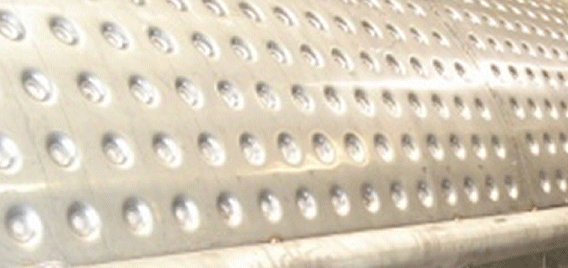
Jacketing a process vessel provided excellent heat transfer in terms of efficiency, control and product quality. All liquids can be used as well as steam and other high temperature vapor circulation. The temperature and velocity of the heat transfer media can be accurately controlled.
The various types of jackets used in process industry are :
- Spirally baffled jackets/ conventional jackets
- Dimple jackets
- Partial-pipe coil /limpet jacket
- Panel type/ plate type coil jackets
Commonly used heat transfer medias include water, steam (various pressures), hot oil (such as Therminol™), and Dowtherm™ vapor.
Matching Jacket Types to Heat Transfer Media
Water: Depending on the process temperature, stress corrosion cracking can sometimes be a concern due to the chlorides usually found in water. In some cases, dimple jackets may requires the use of high-nickel alloys which are very expensive. The half-pipe coil can use 1/4'' thick carbon steel for the jacketing but their economy versus conventional jackets must to be considered. With services involving large volumes of water (used to maintain a high temperature difference) the conventional jacket usually offers the best solution.
Steam: Both dimple and half coil jackets are well suited use with high pressure steam. The dimple jackets are generally limited to 300 psig design pressure while half-coil jackets can be used up to a design pressure of 750 psig. For half-pipe coil jacket, the higher heat flux rate may require multiple sections of jackets to avoid having condensate covering too much of the heat transfer area. For low pressure steam services convention jackets are a much more economical choice.
Hot Oils and Heat Transfer Fluids: Although pressures are usually low when using oils or heat transfer fluids, the temperatures are usually high. The result is low allowable stress values for the inner-vessel material. Therefore both half-pipe jackets and dimple jackets can provide good solutions. Conventional jackets require a greater shell thickness along with expansion joints to eliminate stresses induced by the difference in thermal expansion when the jacket is not manufacturered from the same material as that of shell.
Dowtherm™ Vapors:The ability to vary the distance between the outer and innver vessel walls makes conventional jackets ideally suited to handle Dowtherm™ vapors. Also since Dowtherm vapor has a low enthalpy (1/10 that of steam) a large jacket space is needed for given heat flux. The jacket must be designed in accordance with ASME Code specifications. The maximum allowable space is limited by section UA-104 Paragraph c and s.
2 Comments
Very useful guidance for designing Jacketed vessel. Thank you for your sharing.
thank you, but i have an situation here i already fabricated double jacket tank half pipe but i need another type of jacket to prevent marks of welding on the inner tank walls. kindly see below picture
http://postimg.org/image/4xhiuehkn/
http://postimg.org/image/ctl1tbqt3/
http://postimg.org/image/5cgfruqnr/
cloud you please advise