|
A Process Design Engineers Perspective on Using Equivalent Lengths of Valves and Fittings in Pipeline Pressure Drop Calculations Reader / Author Question and Answer Added at End of Article
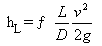
One of the most basic calculations performed by any process engineer, whether in design or in the plant, is line sizing and pipeline pressure loss. Typically known are the flow rate, temperature and corresponding viscosity and Calculating Pressure Drop The most commonly used equation for determining pressure drop in a straight pipe is the Darcy Weisbach equation. One common form of the equation which gives pressure drop in terms of feet of head is given below:
Another common form of the Darcy Weisbach equation that is most often used by engineers because it gives pressure drop in units of pounds per square inch (psi) is:
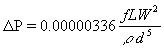
To obtain pressure drop in units of psi/100 ft, the value of 100 replaces L in Equation 2. The total pressure drop in the pipe is typically calculated using these five steps. (1) Determine the total length of all horizontal and vertical straight pipe runs. (2) Determine the number of valves and fittings in the pipe. For example, there may be two gate valves, a 90o elbow and a flow thru tee. (3) Determine the means of incorporating the valves and fittings into the Darcy equation. To accomplish this, most engineers use a table of equivalent lengths. This table lists the valve and fitting and an associated length of straight pipe of the same diameter, which will incur the same pressure loss as that valve or fitting. For example, if a 2 90o elbow were to produce a pressure drop of 1 psi, the equivalent length would be a length of 2 straight pipe that would also give a pressure drop of 1 psi. The engineer then multiplies the quantity of each type of valve and fitting by its respective equivalent length and adds them together. (4) The total equivalent length is usually added to the total straight pipe length obtained in step one to give a total pipe equivalent length. (5) This total pipe equivalent length is then substituted for L in Equation 2 to obtain the pressure drop in the pipe. See any problems with this method? Relationship Between K, Equivalent Length and Friction
Factor The following discussion is based on concepts found in reference 1, the CRANE Technical Paper No. 410. It is the authors opinion that this manual is the closest thing the industry has to a standard on performing various piping calculations. If the reader currently does not own this manual, it is highly recommended that it be obtained. As in straight pipe, velocity increases through valves and fittings at the expense of head loss. This can be expressed by another form of the Darcy equation similar to Equation 1:
When comparing Equations 1 and 3, it becomes apparent that:
K is called the resistance coefficient and is defined as the number of velocity heads lost due to the valve or fitting. It is a measure of the following pressure losses in a valve or fitting:
Pipe friction in the inlet and outlet straight portions of the
valve or fitting is very small when compared to the other three. Since friction
factor and Reynolds Number are mainly related to pipe friction, K can be considered to be
independent of both friction factor and Reynolds Number. Therefore, K is
treated as a constant for any given valve or fitting under all flow conditions, including
laminar flow. Indeed, experiments showed1 that for a given valve or
fitting type, the tendency is for K to vary only with valve or fitting size. Note
that this is also true for the friction factor in straight clean commercial steel pipe as long as flow conditions are in the fully developed
turbulent zone. It was also found that the ratio L/D tends towards a
constant for all sizes of a given valve or
fitting type at the same flow conditions.
The ratio L/D is defined as the equivalent length of the valve or fitting in pipe diameters and L is the equivalent length itself. In Equation 4, ¦ therefore varies only with valve and fitting size and is independent of Reynolds Number. This only occurs if the fluid flow is in the zone of complete turbulence (see the Moody Chart in reference 1 or in any textbook on fluid flow). Consequently, ¦ in Equation 4 is not the same ¦ as in the Darcy equation for straight pipe, which is a function of Reynolds Number. For valves and fittings, ¦ is the friction factor in the zone of complete turbulence and is designated ¦t, and the equivalent length of the valve or fitting is designated Leq. Equation 4 should now read (with D being the diameter of the valve or fitting):
The equivalent length, Leq, is related to ¦t, not ¦, the friction factor of the flowing fluid in the pipe. Going back to step four in our five step procedure for calculating the total pressure drop in the pipe, adding the equivalent length to the straight pipe length for use in Equation 1 is fundamentally wrong. Calculating Pressure Drop, The Correct Way So how should we use equivalent lengths to get the pressure drop contribution of the valve or fitting? A form of Equation 1 can be used if we substitute ¦t for ¦ and Leq for L (with d being the diameter of the valve or fitting):
The pressure drop for the valves and fittings is then added to the pressure drop for the straight pipe to give the total pipe pressure drop. Another approach would be to use the K values of the individual valves and fittings. The quantity of each type of valve and fitting is multiplied by its respective K value and added together to obtain a total K. This total K is then substituted into the following equation:
Notice that use of equivalent length and friction factor in the pressure drop equation is eliminated, although both are still required to calculate the values of K1. As a matter of fact, there is nothing stopping the engineer from converting the straight pipe length into a K value and adding this to the K values for the valves and fittings before using Equation 7. This is accomplished by using Equation 4, where D is the pipe diameter and ¦ is the pipeline friction factor. How significant is the error caused by mismatching friction factors? The answer is, it depends. Below is a real world example showing the difference between the Equivalent Length method (as applied by most engineers) and the K value method to calculate pressure drop. An Example The fluid being pumped is 94% Sulfuric Acid through a 3, Schedule 40, Carbon Steel pipe:
Notes:
The line pressure drop is greater by about 4.5 psi (about 62%)
using the typical equivalent length method (adding straight pipe length to the equivalent
length of the fittings and valves and using the pipe line fiction factor in Equation 1). One can argue that if the fluid is water or a hydrocarbon, the
pipeline friction factor would be closer to the friction factor at full turbulence and the
error would not be so great, if at all significant; and they would be correct. However
hydraulic calculations, like all calculations, should be done in a correct and consistent
manner. If the engineer gets into the habit of performing hydraulic calculations
using fundamentally incorrect equations, he takes the risk of falling into the trap when
confronted by a pumping situation as shown above. Another point to consider is how the engineer treats a reducer
when using the typical equivalent length method. As we saw above, the equivalent
length of the reducer had to be back-calculated using equation 5. To do this, we had
to use ¦t and
K. Why not use these for the rest of the fittings and apply the calculation
correctly in the first place? Final Thoughts - K Values
The 1976 edition of the Crane Technical Paper No. 410 first
discussed and used the two-friction factor method for calculating the total pressure drop
in a piping system (¦ for
straight pipe and ¦t
for valves and fittings). Since then, Hooper2 suggested a 2-K method for
calculating the pressure loss contribution for valves and fittings. His argument was
that the equivalent length in pipe diameters (L/D) and K was indeed a function of Reynolds
Number (at flow rates less than that obtained at fully developed turbulent flow) and the
exact geometries of smaller valves and fittings. K for a given valve or fitting is a
combination of two Ks, one being the K found in CRANE Technical Paper No. 410, designated
KY, and
the other being defined as the K of the valve or fitting at a Reynolds Number equal to 1,
designated K1. The two are related by the following equation: K = K1 / NRE + KY (1 + 1/D) The term (1+1/D) takes into account scaling between different sizes within a given valve or fitting group. Values for K1 can be found in the reference article2 and pressure drop is then calculated using Equation 7. For flow in the fully turbulent zone and larger size valves and fittings, K becomes consistent with that given in CRANE. Darby3 expanded on the 2-K method. He
suggests adding a third K term to the mix. Darby states that the 2-K method does not
accurately represent the effect of scaling the sizes of valves and fittings. The
reader is encouraged to get a copy of this article. The use of the 2-K method has been around since 1981 and does
not appear to have caught on as of yet. Some newer commercial computer
programs allow for the use of the 2-K method, but most engineers inclined to use the K
method instead of the Equivalent Length method still use the procedures given in
CRANE. The latest 3-K method comes from data reported in the recent CCPS Guidlines4
and appears to be destined to become the new standard; we shall see. Conclusion Consistency, accuracy and correctness should be what the
Process Design Engineer strives for. We all add our fat or safety
factors to theoretical calculations to account for real-world situations. It would
be comforting to know that the fat was added to a basis using sound and
fundamentally correct methods for calculations.
REFERENCES
Reader / Author Question and Answers 1. "Could you please give me in layman terms a better definition for K values. I know that K is defined as "the number of velocity heads lost"...But what exactly does that mean???" Well, I'll try to give you the Chemical Engineer's version of the layman answer. Velocity of any fluid increases through pipes, valves and fittings at the expense of pressure. This pressure loss is referred to as head loss. The greater the head loss, the higher the velocity of the fluid. So, saying a velocity head loss is just another way of saying we loose pressure due to and increase in velocity and this pressure loss is measured in terms of feet of head. Now, each component in the system contributes to the amount of pressure loss in different amounts depending upon what it is. Pipes contribute fL/D where L is the pipe length, D is the pipe diameter and f is the friction factor. A fitting or valve contributes K. Each fitting and valve has an associated K. 2. "It appears that the K values in CRANE TP-410 were established using a liquid (water) flow loop. Is this K value also valid for compressible media systems? (Can a K value be used for both compressible and incompressible service?)" Crane also tested their system on steam and air. Now, this is
where things get sticky. As per CRANE TP-410, K values are a function of the size and type
of valve or fitting only and is independent of fluid and Reynolds number. So yes, you can
use it in ALL services, including two-phase flow. However, as I point out towards
the end of my article, there is now evidence that shows using a single K value for the
valve and fitting is not correct and that K is indeed a function of both Reynolds number
and fitting/valve 3. "When answering my first question, you stated: 'Velocity of any fluid increases through pipes, valves and fittings at the expense of pressure.' When you say this, you are talking about compressible (gas) flow right? For example, in a pipe of constant area, the velocity of a gas would increase as the fluid traveled down the pipe (due to the decreasing pressure). However, the velocity of a liquid would remain constant as it traveled down the same pipe (even with the decreasing pressure). Is this a correct statement? Sorry for the confusion. Yes to both of your questions. If you
look at the Bernoulli equation, you will see that velocity cancels out for a liquid as
long as there is no change in pipe size along the way and pressure drop is only a function
of frictional losses and a change in elevation. 4. I'm reading the Crane Technical Paper #410 and I have the following You need a diameter to get velocity. Velocity is lenght/time (for
example, feet/sec). Flow is usually given in either mass units (weight/time or lb/hr for
example) or in volumetric units (cubic feet per minute for example). To get velocity, you
need to divide the volumetric flow by a cross sectional area (square feet). To get an
area, you need a diameter. So the velocity is always based on some diameter. |
|||||||||||||||||||||||||||||||||||||||||||||||||||||||||||||||||||||||||||||||||||||||||||||||||||||||||||||||||||||||||||||||||||||||||||||||||||
ChE Plus Subscriber - Click Here for a Printable Version
Send this Page to a Friend