Your about to read an award winning
article. This article won the 2000 Beychok-Montemayor Award
here at The Chemical Engineers' Resource Page!
Updated
Fall of 2002 (New Additions in Blue)
Experience is typically what turns
a good engineer into a great engineer. An engineer that can look at a pipe and a
flowmeter and guess the pressure drop within 5%. Someone who can at least estimate
the size of a vessel without doing any calculations. When I think of such rules, two
authors come to my mind, Walas and Branan. Dr. Walas' book, Chemical Process
Equipment: Selection and Design has been widely used in the process industry and in
chemical engineering education for years. Mr. Branan has either helped write or edit
numerous books concerning this topic. Perhaps his most popular is Rules of Thumb
for Chemical Engineers. Here, I'll share some of these rules with you along
with some of my own. Now, be aware that these rules are for estimation and are not
necessary meant to replace rigorous calculations when such calculations should be
performed. But at many stages of analysis and design, these rules can save you hours
and hours. As always, if you have some shortcuts that you'd like to add to the list,
email them to me and I'll add
them on. You can also download this page as an Excel 97 file here
(updated). New Note: Thanks to Leopoldo
Cabieses, we now have the Excel spreadsheet available in Spanish. Download the
spanish version here.
Physical Properties
Property
Units
Water
Organic
Liquids
Steam
Air
Organic
Vapors
Heat
Capacity
KJ/kg 0C
4.2
1.0-2.5
2.0
1.0
2.0-4.0
Btu/lb 0F
1.0
0.239-0.598
0.479
0.239
0.479-0.958
Density
kg/m3
1000
700-1500
1.29@STP
(1 bar, 0°C)
lb/ft3
62.29
43.6-94.4
0.08@STP
(14.696 psia and 60°F)
Latent
Heat
KJ/kg
1200-2100
200-1000
Btu/lb
516-903
86-430
Thermal
Cond.
W/m 0C
0.55-0.70
0.10-0.20
0.025-0.070
0.025-0.05
0.02-0.06
Btu/h ft
0F
0.32-0.40
0.057-0.116
0.0144-0.040
0.014-0.029
0.116-0.35
Viscosity
cP
1.8 @ 0 0C
**See
Below
0.01-0.03
0.02-0.05
0.01-0.03
0.57 @ 50
0C
0.28 @ 100
0C
0.14 @ 200
0C
Prandtl
Number
1-15
10-1000
1.0
0.7
0.7-0.8
** Viscosities of organic liquids vary widely with temperature
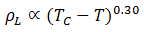
Liquid density varies with temperature by:
Gas
density can be calculated by:
Boiling
Point of Water as a Function of Pressure:
Tbp (°C) = (Pressure (MPa) x (1x10⁹))0.25
Materials of Construction
Material
Advantage
Disadvantage
Carbon
Steel
Low cost, easy to fabricate, abundant, most common material. Resists most
alkaline environments well.
Very
poor resistance to acids and stronger alkaline streams. More brittle than other materials,
especially at low temperatures.
Stainless
Steel
Relatively low cost, still easy to fabricate. Resist a wider variety of
environments than carbon steel. Available is many different types.
No
resistance to chlorides, and resistance decreases significantly at higher temperatures.
254
SMO (Avesta)
Moderate cost, still easy to fabricate. Resistance is better over a wider
range of concentrations and temperatures compared to stainless steel.
Little
resistance to chlorides, and resistance at higher temperatures could be improved.
Titanium
Very good resistance to chlorides (widely used in seawater applications).
Strength allows it to be fabricated at smaller thicknesses.
While
the material is moderately expensive, fabrication is difficult. Much of cost will be in
welding labor.
Pd
stabilized Titanium
Superior resistance to chlorides, even at higher temperatures. Is often
used on sea water application where Titanium's resistance may not be acceptable.
Very
expensive material and fabrication is again difficult and expensive.
Nickel
Very good resistance to high temperature caustic streams.
Moderate
to high expense. Difficult to weld.
Hastelloy
Alloy
Very wide range to choose from. Some have been specifically developed for
acid services where other materials have failed.
Fairly
expensive alloys. Their use must be justified. Most are easy to weld.
Graphite
One of the few materials capable of withstanding weak HCl streams.
Brittle,
very expensive, and very difficult to fabricate. Some stream components have been know to
diffusion through some types of graphites.
Tantalum
Superior resistance to very harsh services where no other material is
acceptable.
Extremely
expensive, must be absolutely necessary.
Cooling Towers
A. With
industrial cooling towers, cooling to 90% of the ambient air saturation level is possible.
B. Relative
tower size is dependent on the water temperature approach to the wet bulb temperature:
Twater-Twb
Relative
Size
5
2.4
15
1.0
25
0.55
C. Water
circulation rates are generally 2-4 GPM/sq. ft (81-162 L/min m2) and air
velocities are usually 5-7 ft/s
(1.5-2.0 m/s)
D.
Countercurrent induced draft towers are the most common. These towers are capable of
cooling to within 2 °F
(1.1 °C) of the wet bulb temperature. A 5-10 °F (2.8-5.5 °C) approach is more
common.
E.
Evaporation losses are about 1% by mass of the circulation rate for every 10 °F (5.5 °C)
of cooling. Drift losses are around 0.25% of the circulation rate. A blowdown
of about 3% of the circulation rate is needed to prevent salt and chemical treatment
buildup.
Conveyors
A. Pneumatic
conveyors are best suited for high capacity applications over distances of up to about 400
ft. Pneumatic conveying is also appropriate for multiple sources and destinations.
Vacuum or low pressure (6-12 psig or 0.4 to 0.8 bar) is used for generate air
velocities from 35 to 120 ft/s (10.7-36.6 m/s). Air requirements are usually in the
range of 1 to 7 cubic feet of air per cubic foot of solids (0.03 to 0.5 cubic meters of
air per cubic meter of solids).
B. Drag-type
conveyors (Redler) are completed enclosed and suited to short distances. Sizes range
from 3 to 19 inches square (75 to 480 mm). Travel velocities can be from 30 to 250
ft/min (10 to 75 meters/min). The power requirements for these conveyors is higher
than other types.
C. Bucket
elevators are generally used for the vertical transport of sticky or abrasive materials.
With a bucket measuring 20 in x 20 in (500 mm x 500 mm), capacities of 1000 cubic
feet/hr (28 cubic meters/hr) can be reached at speeds of 100 ft/min (30 m/min).
Speeds up to 300 ft/min (90 m/min) are possible.
D. Belt conveyors
can be used for high capacity and long distance transports. Inclines up to 30° are
possible. A 24 in (635 mm) belt can transport 3000 cu. ft./h (85 cu m/h) at speeds
of 100 ft/min (30.5 m/min). Speeds can be as high as 600 ft/min (183 m/min).
Power consumption is relatively low.
E. Screw
conveyors can be used for sticky or abrasive solids for transports up to 150 ft (46 m).
Inclines can be up to about 20°. A 12 in (305 mm) diameter screw conveyor
can transport 1000-3000 cu. ft./h (28-85 cu. m/h) at around 40-60 rpm.
Crystallization
A. During
most crystallizations, C/Csat (concentration/saturated concentration) is kept
near 1.02 to 1.05
B. Crystal
growth rates and crystal sizes are controlled by limiting the degree of supersaturation.
C. During
crystallization by cooling, the temperature of the solution is kept 1-2 °F (0.5-1.2 °C)
below the saturation point at the given concentration.
D. A
generally acceptable crystal growth rate is 0.10 - 0.80 mm/h
Drivers and Power Recovery
A.
Efficiencies: 85-95% for motors, 40-75% for steam turbines, 28-38% for gas engines
and turbines.
B. Electric
motors are nearly always used for under 100 HP (75 kW). They are available up to
20,000 HP (14,915 kW).
C. Induction
motors are most popular. Synchronous motors have speeds as low as 150 rpm at ratings
above 50 HP (37.3 kW) only. Synchronous motors are good for low speed reciprocating
compressors.
D. Steam
turbines are seldom used below 100 HP (75 kW). Their speeds can be controlled and
they make good spares for motors in case of a power failure.
E. Gas
expanders may be justified for recovering several hundred horsepower. At lower
recoveries, pressure let down will most likely be through a throttling valve.
Drying of Solids
A. Spray
dryer have drying times of a few seconds. Rotary dryers have drying times ranging
from a few minutes to up to an hour.
B. Continuous
tray and belt dryers have drying times of 10-200 minutes for granular materials or 3-15 mm
pellets.
C. Drum
dryers used for highly viscous fluids use contact times of 3-12 seconds and produce flakes
1-3 mm thick. Diameters are generally 1.5-5 ft (0.5 - 1.5 m). Rotation speeds
are 2-10 rpm and the maximum evaporation capacity is around 3000 lb/h (1363 kg/h).
D. Rotary
cylindrical dryers operate with air velocities of 5-10 ft/s (1.5-3 m/s), up to 35 ft/s
(10.5 m/s). Residence times range from 5-90 min. For initial design purposes,
an 85% free cross sectional area is used. Countercurrent design should yield an exit
gas temperature that is 18-35 °F (10-20 °C) above the solids temperature. Parallel
flow should yield an exiting solids temperature of 212 °F (100 °C). Rotation
speeds of 4-5 rpm are common. The product of rpm and diameter (in feet) should be
15-25.
E. Pneumatic
conveying dryers are appropriate for particles 1-3 mm in diameter and in some cases up to
10 mm. Air velocities are usually 33-100 ft/s (10-30 m/s). Single
pass residence time is typically near one minute. Size range from 0.6-1.0 ft
(0.2-0.3 m) in diameter by 3.3-125 ft (1-38 m) in length.
F. Fluidized
bed dryers work well with particles up to 4.0 mm in diameter. Designing for a gas
velocity that is 1.7-2 times the minimum fluidization velocity is good practice.
Normally, drying times of 1-2 minutes are sufficient in continuous operation.
Drum Type Vessels
A. Liquid drums are usually horizontal. Gas/Liquid separators are usually
vertical
B. Optimum Length/Diameter ratio is usually 3, range is 2.5 to 5
C. Holdup time is 5 minutes for half full reflux drums and gas/liquid separators
Design for a 5-10 minute holdup for drums feeding another column
D. For drums feeding a furnace, a holdup of 30 minutes is a good estimate
E. Knockout drum in front of compressors should be designed for a holdup of
10 times the liquid volume passing per minute.
F. Liquid/Liquid separators should be designed for settling velocities of 2-3
inches/min
G. Gas velocities in gas/liquid separators, velocity = k (liquid density/(vapor
density-1))^0.5,
where k is 0.35
with horizontal mesh deentrainers and 0.167 with
vertical mesh deentrainers. k is 0.1 without
mesh deentrainers and velocity is in ft/s
H. A six inch mesh pad thickness is very popular for such vessels
I. For
positive pressure separations, disengagement spaces of 6-18 inches before the mesh pad and
12 inches after the pad are generally suitable.
Electric Motors and Turbines
A.
Efficiencies range from 85-95% for electric motors, 42-78% for steam turbines
28-38% for gas engines and turbines
B. For
services under 75 kW (100 hp), electric motors are almost always used.
They can be used for services up to about 15000 kW (20000 hp)
C.
Turbines can be justified in services where they will yield several hundred
horsepowers.
Otherwise, throttle valves are used to release pressure.
D. A quick estimate of the energy available to a turbine is given by:
where: Delta H = Actual available energy, Btu/lb
Cp = Heat
Capacity at constant pressure, Btu/lb 0F
T1 = Inlet temperature, 0R
P1 = Inlet pressure, psia
P2 = Outlet pressure, psia
K = Cp/Cv
Evaporation
A. Most
popular types are long tube vertical with natural or forced circulation. Tubes range
from 3/4" to 2.5"
(19-63 mm) in diameter and 12-30 ft (3.6-9.1 m) in length.
B. Forced
circulation tube velocities are generally in the 15-20 ft/s (4.5-6 m/s) range.
C. Boiling
Point Elevation (BPE) as a result of having dissolved solids must be accounted for in the
differences between the solution temperature and the temperature of the saturated vapor.
D. BPE's
greater than 7 °F (3.9 °C) usually result in 4-6 effects in series (feed-forward) as an
economical solution. With smaller BPE's, more effects in series are typically more
economical, depending on the cost of steam.
E. Reverse
feed results in the more concentrated solution being heated with the hottest steam to
minimize surface area. However, the solution must be pumped from one stage to the
next.
F. Interstage
steam pressures can be increased with ejectors (20-30% efficient) or mechanical
compressors (70-75% efficient).
Filtration
A. Initially,
processes are classified according to their cake buildup in a laboratory vacuum leaf
filter :
0.10 - 10.0 cm/s (rapid), 0.10-10.0 cm/min (medium), 0.10-10.0 cm/h (slow)
B. Continuous
filtration methods should not be used if 0.35 sm of cake cannot be formed in less
than 5 minutes.
C. Belts, top
feed drums, and pusher-type centrifuges are best for rapid filtering.
D. Vacuum
drums and disk or peeler-type centrifuges are best for medium filtering.
E. Pressure
filters or sedimenting centrifuges are best for slow filtering.
F.
Cartridges, precoat drums, and sand filters can be used for clarification duties with
negligible buildup.
G. Finely
ground mineral ores can utilize rotary drum rates of 1500 lb/dat ft2 (7335 kg/day m2) at
20 rev/h and 18-25 in Hg (457-635 mm Hg) vacuum.
H. Course
solids and crystals can be filtered at rates of 6000 lb/day ft2 (29,340 kg/day m2) at 20
rev/h and 2-6 in Hg (51-152 mm Hg) vacuum.
Mixing and Agitation
A. Mild
agitation results from superficial fluid velocities of 0.10-0.20 ft/s (0.03-0.06 m/s).
Intense agitation results from velocities of 0.70-1.0 ft/s (0.21-0.30 m/s).
B. For
baffled tanks, agitation intensity is measured by power input and impeller tip speeds:
Power Requirements
Tip Speeds
HP/1000 gal
kW/m3
ft/s
m/s
Blending
0.2-0.5
0.033-0.082
-----
----
Homogeneous
Reaction
0.5-1.5
0.082-0.247
7.5-10.0
2.29-3.05
Reaction
w/ Heat Transfer
1.5-5.0
0.247-0.824
10.0-15.0
3.05-4.57
Liquid-Liquid
Mixtures
5.0
0.824
15.0-20.0
4.57-6.09
Liquid-Gas
Mixtures
5.0-10.0
0.824-1.647
15.0-20.0
4.57-6.09
Slurries
10.0
1.647
-----
----
C. Various
geometries of an agitated tank relative to diameter (D) of the vessel include:
Liquid Level = D
Turbine Impeller Diameter = D/3
Impeller Level Above Bottom = D/3
Impeller Blade Width = D/15
Four Vertical Baffle Width = D/10
D. For
settling velocities around 0.03 ft/s, solids suspension can be accomplished with turbine
or propeller impellers. For settling velocities above 0.15 ft/s, intense propeller
agitation is needed.
E. Power to
mix a fluid of gas and liquid can be 25-50% less than the power to mix the liquid alone.
Pressure and Storage Vessels
Pressure Vessels
A. Design Temperatures between -30 and 345 °C (-22 to 653 °F) is typically
about
25 °C (77 °F) above maximum operating temperature, margins increase above this
range
B. Design pressure is 10% or 0.69 to 1.7 bar (10 to 25 psi) above the maximum
operating
pressure, whichever is greater. The maximum operating pressure is taken as 1.7
bar (25 psi)
above the normal operation pressure.
C. For vacuum operations, design pressures are 1 barg (15 psig) to full vacuum
D. Minimum thicknesses for maintaining tank structure are:
6.4 mm (0.25 in) for 1.07 m (42 in) diameter and under
8.1 mm (0.32 in) for 1.07-1.52 m (42-60 in) diameter
9.7 mm (0.38 in) for diameters over 1.52 m (60 in)
E. Allowable working stresses are taken as 1/4 of the ultimate strength of the
material
F. Maximum allowable working stresses:
Temperature
-20 to 650
°F
750 °F
850 °F
1000 °F
-30 to 345
°C
400 °C
455 °C
540 °C
CS SA203
18759 psi
15650 psi
9950 psi
2500 psi
1290 bar
1070 bar
686 bar
273 bar
302 SS
18750 psi
18750 psi
15950 psi
6250 psi
1290 bar
1290 bar
1100 bar
431 bar
G. Thickness based on pressure and radius is given by:
where pressure is in psig, radius in inches, stress in psi, corrosion allowance
in inches.
**Weld Efficiency can usually be taken as 0.85 for initial design work
H. Guidelines for corrosion allowances are as follows: 0.35 in (9
mm) for known corrosive fluids, 0.15 in (4 mm) for non-corrosive fluids, and 0.06 in (1.5
mm) for steam drums and air receivers.
Storage Vessels
I. For less than 3.8 m3 (1000 gallons) use vertical tanks on legs
J. Between 3.8 m3 and 38 m3 (1000 to 10,000 gallons) use horizontal tanks on
concrete supports
K. Beyond 38 m3 (10,000 gallons) use vertical tanks on concrete pads
L. Liquids with low vapor pressures, use tanks with floating roofs.
M. Raw material feed tanks are often specified for 30 days feed supplies
N. Storage tank capacity should be at 1.5 times the capacity of mobile supply
vessels.
For example, 28.4 m3 (7500 gallon) tanker truck, 130 m3 (34,500 gallon) rail cars
Piping
A. Liquid lines should be sized for a velocity of (5+D/3) ft/s and a pressure
drop of
2.0 psi/100 ft of pipe at pump discharges
At the pump suction, size for (1.3+D/6) ft/s and a pressure drop of 0.4 psi/100
ft of pipe
**D is pipe diameter in inches
B. Steam or gas lines can be sized for 20D ft/s and pressure drops of 0.5 psi/100
ft of pipe
C. Limits on superheated, dry steam or gas line should be 61 m/s (200 ft/s) and a
pressure drop of 0.1 bar/100 m or 0.5 psi/100 ft of pipe. Saturated steam lines
should be limited to 37 m/s (120 ft/s) to avoid erosion.
D. For turbulent flow in commercial steel pipes, use the following:
E. For
two phase flow, an estimate often used is Lockhart and Martinelli:
First,
the pressure drops are calculated as if each phase exist alone in the pipe, then
F. Control valves require at least 0.69 bar (10 psi) pressure drop for
sufficient control
G. Flange ratings include 10, 20, 40, 103, and 175 bar (150, 300, 600,
1500, and 2500 psig)
H. Globe
valves are most commonly used for gases and when tight shutoff is required. Gate
valves are common for most other services.
I.
Screwed fitting are generally used for line sizes 2 inches and smaller.
Larger connections should utilize flanges or welding to eliminate leakage.
J. Pipe Schedule Number = 1000P/S (approximate) where P is the
internal pressure rating in psig and S is the allowable working stress of the material is
psi. Schedule 40 is the most common.
Pumps
A. Power estimates for pumping liquids:
kW=(1.67)[Flow (m3/min)][Pressure drop (bar)]/Efficiency
hp=[Flow (gpm)][Pressure drop (psi)]/1714 (Efficiency)
**Efficiency expressed as a fraction in these relations
B. NPSH=(pressure at impeller eye-vapor pressure)/(density*gravitational
constant)
Common range is 1.2 to 6.1 m (4-20 ft) of liquid
C. An equation developed for efficiency based on the GPSA Engineering Data Book
is:
where Efficiency is in fraction form, F is developed head in feet, G is flow in
GPM
Ranges of applicability are F=50-300 ft and G=100-1000 GPM
Error documented at 3.5%
D. Centrifugal pumps: Single stage for 0.057-18.9 m3/min (15-5000 GPM), 152 m
(500 ft)
maximum
head; For flow of 0.076-41.6 m3/min (20-11,000 GPM) use multistage, 1675 m (5500 ft)
maximum
head; Efficiencies of 45% at 0.378 m3/min (100 GPM), 70% at 1.89 m3/min (500 GPM),
80% at 37.8 m3/min (10,000 GPM).
E. Axial pumps can be used for flows of 0.076-378 m3/min (20-100,000 GPM)
Expect heads up to 12 m (40 ft) and efficiencies of about 65-85%
F. Rotary pumps can be used for flows of 0.00378-18.9 m3/min (1-5000 GPM)
Expect heads up to 15,200 m (50,000 ft) and efficiencies of about 50-80%
G. Reciporating pumps can be used for 0.0378-37.8 m3/min (10-100,000 GPM)
Expect heads up to 300,000 m (1,000,000 ft).
Efficiencies: 70% at 7.46 kW (10 hp), 85% at 37.3 kW (50 hp), and 90% at 373 kW
(500 hp)
Compressors and Vacuum Equipment
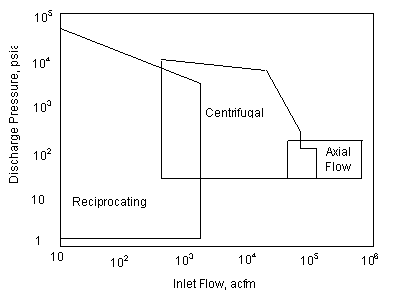
A. The following chart is
used to determine what type of compressor is to be used:
B. Fans should be used to raise pressure about 3% (12 in water), blowers to raise
to less than 2.75 barg (40 psig),
and compressors to higher pressures.
C. The theoretical reversible adiabatic power is estimated by:
Power = m z1 R T1 [({P2 / P1}a
- 1)] / a
where:
T1 is the inlet temperature, R is the gas constant, z1 is the compressibility, m
is the molar flow rate,
a = (k-1)/k , and k = Cp/Cv
D. The outlet for the adiabatic reversible flow, T2 = T1 (P2 / P1)a
E. Exit temperatures should not exceed 204 0C (400 0F).
F. For diatomic gases (Cp/Cv = 1.4) this corresponds to a compression ratio of
about 4
G. Compression ratios should be about the same in each stage for a multistage
unit,
the ratio = (Pn / P1) 1/n, with n stages.
H. Efficiencies for reciprocating compressors are as follows:
65% at compression ratios of 1.5
75% at compression ratios of 2.0
80-85% at compression ratios between 3 and 6
I.
Efficiencies of large centrifugal compressors handling 2.8 to 47 m3/s (6000-100,000 acfm)
at suction is about 76-78%
J. Reciprocating piston vacuum
pumps are generally capable of vacuum to 1 torr absolute, rotary piston types can achieve
vacuums of 0.001 torr.
K. Single stage jet ejectors
are capable of vacuums to 100 torr absolute, two stage to 10 torr, three stage to 1 torr,
and five stage to 0.05 torr.
L. A three stage ejector
requires about 100 lb steam/lb air to maintain a pressure of 1 torr.
M. Air leakage into
vacuum equipment can be approximated as follows:
Leakage = k V(2/3)
where k =0.20 for P >90 torr, 0.08 for 3 < P < 20 torr, and 0.025 for P < 1
torr
V = equipment volume in cubic
feet
Leakage = air leakage into
equipment in lb/h
Heat Exchangers
A. For the heat exchanger equation, Q = UAF (LMTD), use F = 0.9 when charts for
the LMTD correction
factor are not available
B. Most commonly used tubes are 3/4 in. (1.9 cm) in outer diameter on a 1 in
triangular spacing at 16 ft (4.9 m) long.
C. A 1 ft (30 cm) shell will contains about 100 ft2 (9.3 m2)
A 2 ft (60 cm) shell will contain about 400 ft2 (37.2 m2)
A 3 ft (90 cm) shell will contain about 1100 ft2 (102 m2)
D. Typical velocities in the tubes should be 3-10 ft/s (1-3 m/s) for liquids
and30-100 ft/s (9-30 m/s) for gases
E. Flows that are corrosive, fouling, scaling, or under high pressure are usually
placed in the tubes
F. Viscous and condensing fluids are typically placed on the shell side.
G. Pressure drops are about 1.5 psi (0.1 bar) for vaporization and 3-10 psi
(0.2-0.68 bar) for other services
H. The minimum approach temperature for shell and tube exchangers is about 20 °F
(10 °C) for fluids and
10 °F (5 °C) for refrigerants.
I. Cooling tower water is typically available at a maximum temperature of 90 °F
(30 °C) and should be
returned to the tower no higher than 115 °F (45 °C)
J. Shell and Tube heat transfer coefficient for estimation purposes can be found
in many reference books
or an online list can be found at one of the two following addresses:
A. For
ideal mixtures, relative volatility can be taken as the ratio of pure component vapor
pressures
B. Tower operating pressure is most often determined by the cooling medium in
condenser or the
maximum allowable reboiler temperature to avoid degradation of the process fluid
C. For sequencing columns:
1. Perform the easiest separation first (least trays and lowest reflux)
2. If relative volatility nor feed composition vary widely, take products off one
at time
as the overhead
3. If the relative volatility of components do vary significantly, remove
products in order
of decreasing volatility
4. If the concentrations of the feed vary significantly but the relative
volatility do not,
remove products in order of decreasing concentration.
D. The most economic reflux ratio usually is between 1.2Rmin and 1.5Rmin
E. The most economic number of trays is usually about twice the
minimum number of trays.
The minimum number of trays is
determined with the Fenske-Underwood Equation.
F. Typically, 10% more trays than are calculated are specified for a tower.
G. Tray spacings should be from 18 to 24 inches, with accessibility in mind
H. Peak
tray efficiencies usually occur at linear vapor velocities of 2 ft/s (0.6 m/s) at moderate
pressures,
or 6 ft/s (1.8 m/s) under vacuum conditions.
I. A typical pressure drop per tray is 0.1 psi (0.007 bar)
J. Tray
efficiencies for aqueous solutions are usually in the range of 60-90% while gas absorption
and
stripping typically have efficiencies closer to 10-20%
K. The three most common types of trays are valve, sieve, and bubble cap. Bubble
cap trays are
typically used when low-turn down is expected or a lower pressure drop than the
valve or sieve
trays can provide is necessary.
L. Seive tray holes are
0.25 to 0.50 in. diameter with the total hole area being about 10% of the total
active tray area.
M. Valve trays typically
have 1.5 in. diameter holes each with a lifting cap. 12-14 caps/square foot
of tray is a good benchmark. Valve trays
usually cost less than seive trays.
N. The
most common weir heights are 2 and 3 in and the weir length is typically 75% of the tray
diameter
O
. Reflux pumps should be at least 25% overdesigned
P. The optimum Kremser absorption factor is usually in the range of 1.25 to 2.00
Q.
Reflux drums are almost always horizontally mounted and designed for a 5 min holdup at
half of the
drum's capacity.
R. For
towers that are at least 3 ft (0.9 m) is diameter, 4 ft (1.2 m) should be added to the top
for vapor
release
and 6 ft (1.8 m) should be added to the bottom to account for the liquid level and
reboiler return
S. Limit tower heights to 175 ft (53 m) due to wind load and foundation
considerations.
T. The Length/Diameter ratio of a tower should be no more than 30 and preferrably
below 20
U. A rough estimate of reboiler duty as a function of tower diameter is given by:
Q = 0.5 D2 for pressure distillation
Q = 0.3 D2 for atmospheric distillation
Q = 0.15 D2 for vacuum distillation
where Q is in Million Btu/hr and D is tower diameter in feet
Packed Towers
A. Packed
towers almost always have lower pressure drop than comparable tray towers.
B.
Packing is often retrofitted into existing tray towers to increase capacity or separation.
C. For
gas flowrates of 500 ft3/min (14.2 m3/min) use 1 in (2.5 cm) packing, for gas flows
of 2000 ft3/min (56.6 m3/min) or more, use 2 in (5 cm) packing
D. Ratio of tower diameter to packing diameter should usually be at least 15
E. Due to
the possibility of deformation, plastic packing should be limited to an unsupported
depth of 10-15 ft (3-4 m) while metallatic packing can withstand 20-25 ft (6-7.6
m)
F. Liquid
distributor should be placed every 5-10 tower diameters (along the length) for pall rings
and every 20 ft (6.5 m) for other types of random packings
G. For
redistribution, there should be 8-12 streams per sq. foot of tower area for tower larger
than
three feet in diameter. They should be even more numerous
in smaller towers.
H. Packed columns should operate near 70% flooding.
I. Height Equivalent to Theoretical Stage (HETS) for vapor-liquid contacting is
1.3-1.8 ft
(0.4-0.56 m) for 1 in pall rings and 2.5-3.0 ft (0.76-0.90 m) for 2 in pall rings
J. Design pressure drops should be as follows:
Service
Pressure drop (in water/ft packing)
Absorbers and Regenerators
Non-Foaming Systems
0.25 -
0.40
Moderate Foaming Systems
0.15 -
0.25
Fume Scrubbers
Water Absorbent
0.40 -
0.60
Chemical Absorbent
0.25 -
0.40
Atmospheric or Pressure Distillation
0.40 -
0.80
Vacuum Distillation
0.15 -
0.40
Maximum for Any System
1.0
**For packing factors and more on packed column design see:
A. The rate of reaction
must be established in the laboratory and the residence time or space velocity
will eventually have to be determined in a pilot plant.
B. Catalyst particle
sizes: 0.10 mm for fluidized beds, 1 mm in slurry beds, and 2-5 mm in fixed beds.
C. For
homogeneous stirred tank reactions, the agitor power input should be about
0.5-1.5 hp/1000 gal (0.1-0.3 kW/m3), however, if heat is to be transferred,
the agitation should be about three times these amounts.
D. Ideal
CSTR behavior is usually reached when the mean residence time is 5-10 times
the
length needed to achieve homogeneity. Homogeneity is typically reached with
500-2000 revolutions of a properly designed stirrer.
E.
Relatively slow reactions between liquids or slurries are usually conducted most
economically in a battery of 3-5 CSTR's in series.
F.
Tubular flow reactors are typically used for high productions rates and when the
residence
times are short. Tubular reactors are also a good choice when significant
heat transfer to or from the reactor is necessary.
G. For
conversion under 95% of equilibrium, the reaction performance of a 5 stages
CSTR approaches that of a plug flow reactor.
H.
Typically the chemical reaction rate will double for a 18 °F (10 °C) increase in
temperature.
I. The
reaction rate in a heterogeneous reaction is often controlled more by the rate of
heat or mass transfer than by chemical kinetics.
J.
Sometimes, catalysts usefulness is in improving selectivity rather than increasing
the rate of the reaction.
Refrigeration and Utilities
A. A ton
of refrigeration equals the removal of 12,000 Btu/h (12,700 kJ/h) of heat
B. For
various refrigeration temperatures, the following are common refrigerants:
Temp
(°F)
Temp
(°C)
Refrigerant
0 to 50
-18 to
-10
Chilled
brine or glycol
-50 to
-40
-45 to
-10
Ammonia,
freon, butane
-150 to
-50
-100 to
-45
Ethane,
propane
C.
Cooling tower water is received from the tower between 80-90 °F (27-32 °C)
and
should be returned between 115-125 °F (45-52 °C) depending on the size
of the
tower. Seawater should be return no higher than 110 °F (43 °C)
D. Heat
transfer fluids used: petroleum oils below 600 °F (315 °C), Dowtherms
or other
synthetics below 750 °F (400 °C), molten salts below 1100 °F (600 °C)
E. Common compressed air
pressures are: 45, 150, 300, and 450 psig
F. Instrument air is
generally delivered around 45 psig with a dewpoint 30 °F below the coldest expected
ambient temperature.