|
Many people overlook the importance of insulation in the
chemical industry. Some estimates have predicted that insulation in U.S. industry
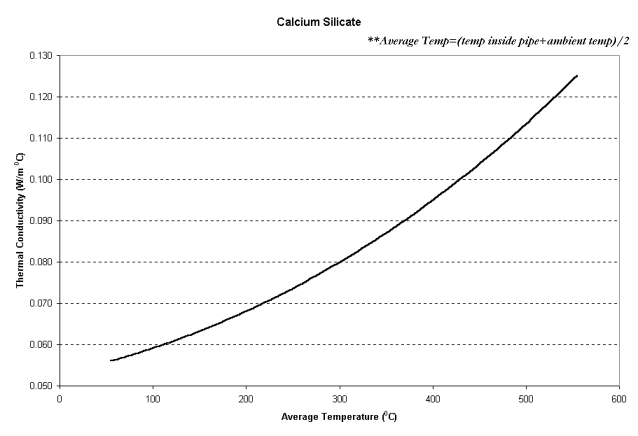
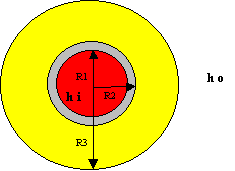
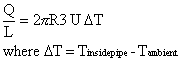
alone saves approximately 200 million barrels of oil every year. While placing Figure 1: Thermal Conductivity of Calcium Silicate Insulation Figure 2: Thermal Conductivity of Fiberglass Insulation A Brief Look at Theory The most basic model for insulation on a pipe is shown below. R1 and R2 show the inside and outside radius of the pipe respectively. R3 shows the radius of the insulation. Typically when dealing with insulations, engineers must be concerned with linear heat loss or heat loss per unit length.
Thinking About Insulation from All Sides Three major factors play an important role
in determining insulation type and thickness. Here, we'll focus on resolving the
thickness issue since many manufacturing facilities have a "standard" type of
insulation that they use. The three key factors to examine are: Economics Economic thickness of insulation is a well documented calculation procedure. The calculations typically take in the entire scope of the installation including plant depreciation to wind speed. Data charts for calculating the economic thickness of insulation are widely available. Below are links to economic thickness tables that have been adapted from Perry's Chemical Engineers' Handbook: Table 1: Economic Indoor Insulation Thickness (American Units) Table 2: Economic Indoor Insulation Thickness (Metric Units) Table 3: Economic Outdoor Insulation Thickness (American Units) Table 4: Economic Outdoor Insulation Thickness (Metric Units) A small, DOS based computer program is also available to help determine economic thickness of insulation. Download this program here! (Also available in Software Corner) Example of Economic Thickness Determination: Safety Pipes that are readily accessible by workers are subject to safety constraints. The recommended safe "touch" temperature range is from 130 0F to 150 0F (54.4 0C to 65.5 0C). Insulation calculations should aim to keep the outside temperature of the insulation around 140 0F (60 0C). An additional tool employed to help meet this goal is aluminum covering wrapped around the outside of the insulation. Aluminum's thermal conductivity of 209 W/m K does not offer much resistance to heat transfer, but it does act as another resistance while also holding the insulation in place. Typical thickness of aluminum used for this purpose ranges from 0.2 mm to 0.4 mm. The addition of aluminum adds another resistance term to Equation 1 when calculating the total heat loss:
However, when considering safety, engineers need a quick way to calculate the surface temperature that will come into contact with the workers. This can be done with equations or the use of charts. We start by looking at another diagram:
At steady state, the heat transfer rate will be the same for each layer:
Rearranging Equation 4 by solving the three expressions for the temperature difference yields:
Each term in the denominator of Equation 5 is referred to as the "resistance" of each layer. We will define this as Rs and rewrite the equation as:
Since the heat loss is constant for each layer, use Equation 4 to
calculate Q from the bare pipe, then solve Equation 6 for T4 (surface temperature).
Use the economic thickness of your insulation as a basis for your calculation, after all,
if the most affordable layer of insulation is safe, that's the one you'd want to
use. If the economic thickness results in too high a surface temperature, repeat the
calculation by increasing the insulation thickness by 1/2 inch each time until a safe
touch temperature is reached.
With the help of Figure 4 and Table 5 (or similar data for another material you may be dealing with), the relation:
can be used to easily determine how much insulation will be needed to achieve a specific surface temperature. Let's look at an example to illustrate the various uses of this equation. Example of Outer Surface Temperature Determination:
Tsurface - Tambient = 130 0F - 85 0F = 45 0F,
from Table 5 we estimate a Rs value for aluminum at 0.865 h ft2 0F/Btu.
From Figure 4 above, an equivalent thickness of 6 in corresponds to an actual thickness of nearly 5.0 in of insulation. Process Conditions The temperature of a fluid inside an insulated pipe is an important process variable that must be considered in many situations. Consider the length of pipe connecting two pieces of process equipment shown below:
In order to predict T2 for a given insulation
thickness, we first make the following assumptions:
Another heat balance equation yields:
Setting Equation 8 equal to Equation 9 and solving for T2 yields:
Equation 10 provides another useful tool for analyzing insulation and its impact on a process. Equation 10 has been incorporated into the "Insulated Pipe Temperature Prediction Spreadsheet" available at Software Corner. You can also download this spreadsheet here. One example may be the importance of designing insulation thickness to prevent condensation on cold lines. Usually, when we hear the word "insulation" we instantly think of hot lines. However, there are times when insulation is used to prevent heat from entering a line. In this situation, the dew point temperature of the ambient air must be considered. Table 6 and Table 7 show dewpoint temperatures as a function of relative humidity and dry bulb temperatures. Table 6: Dew Point Temperatures of Air in Degrees Fahrenheit Table 7: Dew Point Temperatures of Air in Degrees Celsius It is crucial that sufficient insulation is added so that the outer temperature of the insulation remains above the dewpoint temperature. At the dewpoint temperature, moisture in the air will condense onto the insulation and essentially ruin it. Practical Example
In the figure above, a typical reactor feed preheater (interchanger) is shown. The heat exchanger resides on the first level of the structure while the reactor is on the second level. During construction, stream 2 was not insulated because it runs from the exchanger directly to the ceiling away from workers so it posed no safety risk. The reaction is endothermic, so heat is supplied by a Dowtherm jacket surrounding the vessel. The equivalent length of the pipe containing stream 2 is 100 meters. A recent rise is fuel oil costs (which is used to heat the Dowtherm) has prompted the company to search for ways to conserve energy. With the data provided below, you recognize an opportunity for energy savings. Any increase in the reactor feed temperature will reduce the reactor duty and save money. What is the current reactor entrance temperature compared with the entrance temperature after applying the economic insulation thickness to the pipe? Data: Calculations: Temperature difference with insulation is nearly 5 0C. While this doesn't sound too dramatic, consider the energy savings over one year with the insulation: Q = mass flow x Cpfluid x temperature difference By insulating the pipe, energy costs have decreased by nearly $187,000 per year Summary There are many factors to consider when thinking about insulation. Insulation save money for certain, but it can also be effective as a safety and process control device. Insulation can be used to regulate process temperatures, protect workers from serious injury, and save thousands of dollars in energy costs. One should never overlook it's usefulness. It's also bad practice to consider only one of the important factors discussed in this article. The key is to consider all factors that will be affected by installing insulation on a pipe or any other piece of equipment. |
ChE Plus Subscriber - Click Here for a Printable Version
Send this Page to a Friend