Newest Articles
ChExpress-June 23, 2009
ChExpress-June 9, 2009
ChExpress-May 26, 2009
ChExpress-May 14, 2009
ChExpress-April 28, 2009
ChExpress-April 14, 2009
ChExpress-March 31, 2009
Electrical Process Tomography
Biodiesel: The Road Ahead
Methanol Plant Capacity Enhancement
Plate and Frame Heat Exchangers: Preliminary Design
Compressor Surging Under Control
Using RPM to Manage Maintenance
Plant and Equipment Wellness, Part 1: Observing Variability


Jacketed Vessel Design

Published: January 8, 2008

More on Heat Transfer from Cheresources.com:
FREE Resources
Article: Basics of Vaporization
Article: Specifying Liquid-Liquid Heat Exchangers
Article: Basics of Industrial Heat Transfer
Article: Plate and Frame Heat Exchangers: Preliminary Design
Questions and Answers: Heat Transfer
Experienced-Based Rules for Heat Exchangers and Evaporators
ChE Links: Search for "Heat Transfer"
Students: Ask a Question in our Forums
Professionals: Ask a Question in our Forums
Purchase / Subscription Resources
Book: Available Titles
Online Store: Shell and Tube Exchanger Specification Sheet
Online Store: Heat Transfer Category
Online Store: TANKJKT (Jacketed Vessel Design Software)

Jacketing a process vessel provided excellent heat transfer in terms of efficiency, control and product quality. All liquids can be used as well as steam and other high temperature vapor circulation.  The temperature and velocity of the heat transfer media can be accurately controlled.  The various types of jackets used in process industry are :

n  Spirally baffled jackets/ conventional jackets

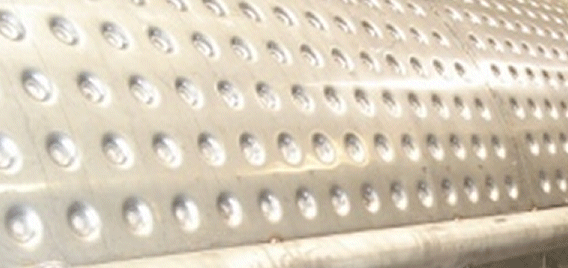
n  Dimple jackets

n  Partial-pipe coil /limpet jacket

n  Panel type/ plate type coil jackets

Commonly used heat transfer medias include water, steam (various pressures), hot oil (such as Therminol™), and Dowtherm™ vapor.

Matching Jacket Types to the Heat Transfer Media

Water: Depending on the process temperature, stress corrosion cracking can sometimes be a concern due to the chlorides usually found in water.  In some cases, dimple jackets may requires the use of high-nickel alloys which are very expensive.  The half-pipe coil can use 1/4’’ thick carbon steel for the jacketing but their economy versus conventional jackets must to be considered. With services involving large volumes of water (used to maintain a high temperature difference) the conventional jacket usually offers the best solution.

Steam: Both dimple and half coil jackets are well suited use with high pressure steam. The dimple jackets are generally limited to 300 psig design pressure while half-coil jackets can be used up to a design pressure of 750 psig. For half-pipe coil jacket, the higher heat flux rate may require multiple sections of jackets to avoid having condensate covering too much of the heat transfer area. For low pressure steam services convention jackets are a much more economical choice.

Hot Oils and Heat Transfer Fluids: Although pressures are usually low when using oils or heat transfer fluids, the temperatures are usually high. The result is low allowable stress values for the inner-vessel material.   Therefore both half-pipe jackets and dimple jackets can provide good solutions.   Conventional jackets require a greater shell thickness along with expansion joints to eliminate stresses induced by the difference in thermal expansion when the jacket is not manufacturered from the same material as that of shell.

Dowtherm™ Vapors:   The ability to vary the distance between the outer and innver vessel walls makes conventional jackets ideally suited to handle Dowtherm™ vapors. Also since Dowtherm vapor has a low enthalpy (1/10 that of steam) a large jacket space is needed for given heat flux.  The jacket must be designed in accordance with ASME Code specifications.  The maximum allowable space is limited by section UA-104 Paragraph (c) and (s).

Conventional Jackets

"Conventional jackets" can be divided into two (2) main categories: baffled and non-baffled.  Baffled jackets often utilize what is known as a spirally wound baffle.  The baffle

jacketed_vessel_design1.gif (18514 bytes)
Figure 1: Conventional Jacket

consist of a metal strip wound around the inner vessel wall from the jacket utility inlet to the utility outlet.  The baffle directs the flow in a spiral path with a fluid velocity of 1-4 ft/s.  The fabrication methods does allow for small internal leakage or bypass around the baffle.   Generally, bypass flows can exceed 1/3 to 1/2 of the total circulating flow.

Conventional baffled jackets are usually applied with small vessels using high temperatures where the internal pressure in more than twice the jacket pressure.

Spirally baffled jackets are limited to a pressure of 100 psig because vessel wall thickness becomes large and the heat transfer is greatly reduced.  In the case of an alloy reactor, a very costly vessel can result.  For high temperature applications, the thermal expansion differential must be considered when choosing materials for the vessel and jacket.  Design and construction details are given in Division 1 of the ASME Code, Section VIII, Appendix IX, "Jacketed Vessel".

Heat Transfer Coefficients: Conventional Jacket without Baffles

jacketed_vessel_design2.gif (4676 bytes) (hj De / k) = 1.02 (NRe) 0.45 (NPr) 0.33 (De/ L) 0.4 (Djo/ Dji) 0.8 (NGr) 0.05

Where:
hj = Local heat transfer coefficient on the jacket side
De = Equivalent hydraulic diameter
NRe = Reynolds Number
NPr = Prandtl Number
L = Length of jacket passage
Djo = Outer diameter of jacket
Dji = Inner diameter of jacket
NGr = Graetz number


The Reynolds Number is defined as:

NRe = DVr/m
Where D is the equivalent diameter, V is the fluid velocity, r is the fluid density, m and is the fluid viscosity.

The Prandtl Number is defined as:

NPr = Cp m / k
Where Cp is the specific heat,
m is the viscosity, and k is the thermal conducitivity of the fluid.

The Graetz Number is defined as:

NGr = (m Cp) / (k L)
Where m is the mass flow rate, Cp is the specific heat, k is the thermal conducitivity, and L is the jacket passage length.

The equivalent diameter is defined as follows:

De = Djo-Dji for laminar flow
De = ((Djo)2 - (Dji)2)/Dji for turbulent flow


next page >


By: Santosh Singh, Guest Author

Please direct inquiries to:

jacketed_vessel_design_email.gif (2351 bytes)


ChE Plus Subscriber - Click Here for a Printable Version

Send this Page to a Friend

Fill out your email address to
receive notification of site updates
and instantly receive five technical
questions and answers
!
Email Address:
First Name:
Last Name:

State:

Country:

Industry:

Position:

Signup Remove