Steam
Tracing with MS Excel is presented as a guide to understanding how the spreadsheet
"steam_tracing.xls" works to perform various calculations associated with steam
tracing. This spreadsheet by Andre de Lange from South Africa was the winner of our
2005 Spreadsheet Competition. The spreadsheet, available in both Imperial and SI
units, is available for download here.
If
you're using Excel 2007, use this version of
the spreadsheet.
Introduction
Heat
tracing is used to prevent heat loss from process fluids being transported in process
fluid pipes, when there is risk of damage to piping, or interference with operation such
as fouling or blockage, caused by the congealing, increase in viscosity, or separation of
components, in the fluid below certain temperatures, or when there is risk of formation of
corrosive substances or water due to condensation in corrosive services. This
prevention of heat loss is accomplished by employing electrical tracing, or steam tracing,
and insulating both the process fluid pipe and the tracer together, using appropriate
insulation lagging, in an attempt to minimise heat loss from the pipe and tracer to their
surroundings.
The existing software that was used to design steam tracing had to be evaluated in terms
of its accuracy and reliability, as problems associated with steam tracing designed with
the existing software have occurred in the past.
A software
simulation had to be designed that could compare theoretical inputs and outputs with that
of an existing simulation used to design steam tracing, as well as compare it to existing
installed steam tracing, in order to determine where improvements in the software could be
made.
The new software
had to use the outputs from the existing software as inputs and its outputs had to
correspond to the inputs of the existing software. Other important evaluations were also
included in the new software.
Theory
The term Heat Tracing is
inclusive for two methods used in the conservation of temperature. The first method is
known as electrical heat tracing, and the second is known as steam tracing.
Electrical heat tracing may
be described as an insulated electrical heating cable, which is spiralled around the
process fluid pipe, after which the pipe and tracing is insulated with the appropriate
type and thickness of insulation lagging material. While this method of heat tracing
may be installed with
In order follow
the theory of the spreadsheet, download the
nomenclature sheet in Adobe Acrobat reader format.
relative ease
compared to steam tracing, it is more expensive, and poses several risks. The most
important of these, being the risk of electric spark, which may cause electric shock or
ignite flammable substances resulting in explosions or fire. If electrical heat
tracing is not carefully controlled, there is also the possibility that the cable could
overheat and damage the pipe or insulation. This also renders the tracing cable
unusable and the cable needs to be replaced.
Steam tracing is
described by attaching a smaller pipe containing saturated steam, also known as the
tracer, parallel to the process fluid pipe. The two pipes are then also
insulated together with the specified insulation and jacketed if necessary. Steam
tracing is more labor intensive to install than electrical heat tracing, but there are
very few risks associated with it. The temperature of the tracer also cannot exceed
the maximum saturation temperature of the steam, as it operates at specific steam
pressures.
Steam tracing may
be done in one of two ways. Bare steam tracing is the most popular choice as it is
fairly easily installed and maintained and it is ideally suited to lower temperature
requirements. It is simply composed of a half inch or three quarters of an inch pipe
attached to the process fluid pipe by straps and both pipes are then insulated together.
The other available option is to make use of cemented steam tracing, during which
heat conductive cement is placed around the steam tracer running parallel to the process
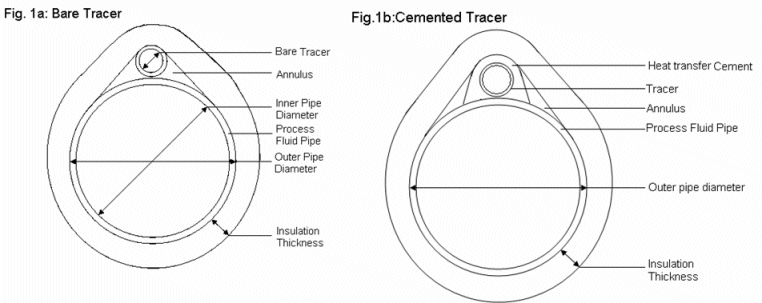
fluid pipe, (shown in figure 1b), in an attempt to increase the contact area available for
heat transfer, between the tracer and the process fluid pipe.
It
is necessary to foster a better understanding of the heat loss distribution through an
insulated pipe containing steam tracing, before continuing the discussion. For this
purpose, detailed diagrams depicting the cross-sections of the two types of tracing
methods are given below, in figures 1a and b:
Because
the area around the process fluid pipe and tracer cannot be accurately described simply by
assuming perfect cylindrical geometry, provision had to be made for a realistic impression
of the true geometry. Detailed derivations of formulas are included in Appendix 1.
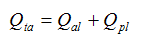
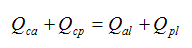
Heat transfer
across a surface occurs according to the following equation:(Coulson & Richardson, 1999:634-688)
(2.1)
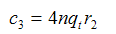
The following
equations were derived in determining the different areas across which heat transfer
occurs:
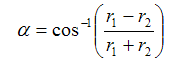
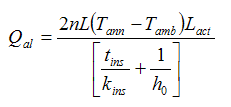
(2.2)
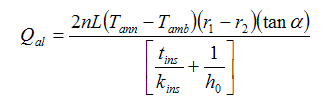
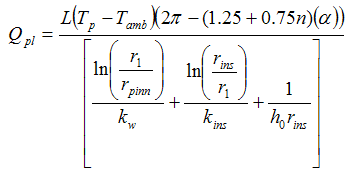
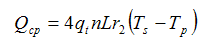
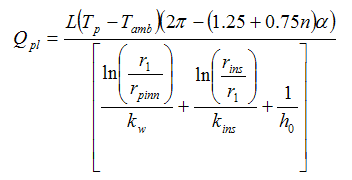
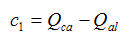
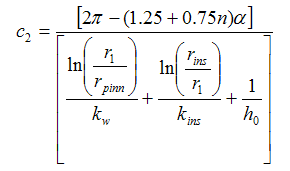
For bare
tracing, the following formulas were derived:

(2.3)
(2.4)
(2.5)
(2.6)
(2.7)
(2.8)
(2.9)
(2.10)
(2.11)
(2.12)
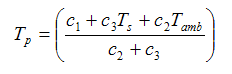
The following
equation was used to determine the hottest surface temperature for bare tracing: (Le Roux,
D.F. (1997) Thermal Insulation and Heat Tracing, Guideline presented by D.F.
le Roux, Secunda)
(2.13)
(2.14)
(2.15)
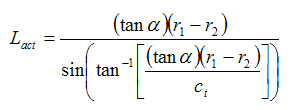
For cemented tracing, the following
formulas were derived:
(2.16)
(2.17)
(2.18)
(2.19)
(2.20)
(2.21)
(2.22)
(2.23)
(2.24)
(2.25)
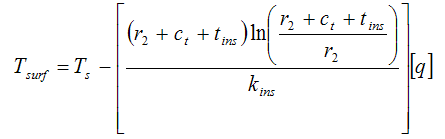
The following equation was used to
determine the hottest surface temperature for cemented tracing:
(2.26)
where
(2.27)
Refer
to Appendix 2 for a table of qt vs.
NPS. (Table 3)
Experimental
The
cross sections of the bare traced and cemented traced pipes are given in figures 3a and
3b, respectively. These figures illustrate how the geometric approach was used in
describing the heat loss through the system, taking into account that spherical geometry
was not assumed.
The
independent variables for the design were as follows, and were all specified variables in
the software simulation:
Time,
s
Pipe
Length, (0 to maximum length for steam trap), m
Steam
Pressure, (240 to 1700kPa)
Nominal
process fluid pipe size, (0.5
to 48 inches)
Amount
of available tracers (0 to 5)
Nominal
pipe size of tracer pipe, (0.5 or 0.75 inches)
Insulation
thickness, (0 to process fluid pipe diameter), m
Emissivity
of insulation lagging (0
to 1)
Ambient
Temperature, (-10 to 50 șC)
Wind
velocity, (0 to 72km/h)
The
dependent variables for the simulation were as follows:
Annulus
Temperature, (Process fluid temperature
to Steam Temperature)
Saturated
Steam Temperature, (126.1 to 204.3șC)
Steam
Consumption, (0 to 50kg/h)
Process
Fluid Temperature,(0 to 600șC)
Pipe
Outer Radius,(10.668 to 609.62mm)
Pipe
Wall Thickness, (1.3974 to 15.6869mm)
Pipe
Inner Radius, (6.401 to 1219.2mm)
Pipe
Wall Thermal Conductivity,(16 to 401W/mK)
Steam
Tracer Outside Radius,(6.35 to 9.53mm)
Maximum
Tracer Length,(30 to 60m)
Thermal
Conductivity of insulation(0.01241 to 0.1120 W/mK)
Average
Insulation Temperature,(Ambient
temp. to Steam temp.)
Surface
Temperature,(N/A), K
Surface
Film Coefficient, (N/A), W/m2K
The
main deliverable was to obtain the minimum temperature at which the process fluid had to
enter the pipeline, but other information such as the wall temperature and steam
consumption were also important.
The
interface designed for the simulation is shown in Fig. 3c and was written in Microsoft
Excel:
Fig. 3c, Interface
The
detailed design and calculations can be found in Appendix
1. The design was done following an unconventional approach, in an attempt to make as
few assumptions as possible.
Most
of the equations were fundamentally derived, but some equations were employed from other
sources. (See References)
All
the necessary equations were developed and simplified to eliminate ambiguity. The
equations were then solved simultaneously and by making use of iterations.
The
inputs to the simulation were highlighted in yellow, on the left side of the page, and the
outputs were highlighted blue, on the right hand side, to eliminate ambiguity in deciding
which were inputs and which were outputs.
The
inputs section mostly made use of drop-down menus to facilitate data input, and mostly
made use of referencing techniques to look up the necessary values used in the
calculations. For example, the user was only required to choose the NPS of the process
fluid pipe, and the schedule number, and the program automatically looked up the outer
diameter, inside diameter and wall thicknesses from a table containing accurate standard
values for pipe sizes.
Also,
the user was only required to specify the insulation material type, steam pressure, and
ambient temperature, which the program used to calculate an average insulation
temperature, and interpolate between different k-values, to obtain the specific thermal
conductivity at that specific temperature, since thermal conductivity is temperature
dependent. The program also used the lagging emissivity, together with the ambient
temperature, surface temperature and wind velocity, to calculate an exact value for the
surface film coefficient on the outside, which needed to be very accurate.
The
program was also able to calculate a maximum surface temperature, to ensure safety
protection for personnel, as the surface temperature, by standard, is not allowed to
exceed 60 șC. Temperatures higher than this would result in injury caused by touching the
outside surface.
The
steam consumption was also calculated by determining the heat loss from the system for a
certain length of pipe. The steam is invariably subject to heat loss, and thus
condensation, when sufficient heat has been lost. This corresponds to the maximum length
of a tracer. Fresh, saturated steam then needs to be re-introduced into the system, to
ensure efficient operation, and a steam trap needs to be installed at the end of the
maximum length, to collect all the condensate which has formed. The condensate may be
recycled to create new steam.
The
simulation made use of macros, in the sense that the program automatically performs the
calculations necessary to converge the answers to a final answer, by simply requiring the
user to press a shortcut key.
Results
and Discussion
Due to the nature of the
project, definite answers are not possible to obtain, but rather different simulations
could be run and each time the answers could be evaluated. As an example, one specific run
could be described in terms of its equations as follows:
Consider the Bare Tracer.
Firstly, the inputs field
has to be completed (see Table 1):
Table 1: Input Fields
After this has been done,
the outputs section may be calculated:
Some of the outputs are
values found in making use of references from other tables. These are shown first in Table
2.
Table 2: Output Fields
This information can now
be used together with the inputs section to calculate the remaining outputs.
Firstly, the Average
Insulation Temperature is calculated from equation (2.9):
it is found thatTins=36.67 șC
It should be noted that
the Process fluid Temperature is not known yet, so this is not a final answer.
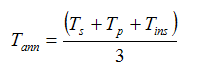
Secondly, the Annulus
Temperature may be calculated from eq. (2.8):
Tann=76.4
șC
Since Tp is
not known yet, and Tins has not yet been assigned a definite value, this value
is also not fixed yet.
Now, the Average
Surface Temperature needs to be calculated. This value may be approximated by
assuming that about 80% of the average surface temperature is due to the process fluid
temperature and the remaining 20% is made up of the surface temperature on the tracer
side. The Average Surface Temperature may then be calculated as follows.
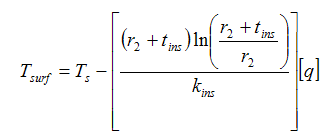
From Eq.(2.13) and (2.14):
for the tracer side
and
for the process fluid pipe side.
Therefore,
The surface temperature is now
calculated by making use of iterations to obtain the final value of
Tsurf)Avg = 14.991 șC
This causes the value of q to change
until it stabilizes to its final answer
Technically speaking, one has to
calculate the area ratios that the process fluid pipe, annulus length and tracer each
contribute, calculate each areas surface temperature, and obtain the average value
for the surface temperature accordingly, but due to the limited capacity of Microsoft
Excel, this method was tried and it failed, because Excel could not perform all the
iterations necessary to do the calculations. The above calculation has shown to give
satisfactory results for most situations.
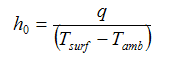
As a next step, the surface coefficient
needs to be calculated using Eq.(2.15):
The value for the surface coefficient
then becomes: h0=10.1
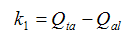
k1 is calculated using Eq.(2.10): but according to
Eq.(2.5),
and
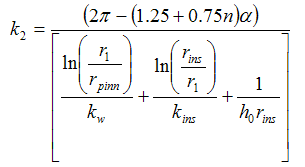
therefore, k1=18.21340591 k2 may
then be calculated using Eq.(2.11):
and therefore amounts tok2= 0.489641399
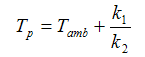
Finally the Process Fluid
Temperature can be calculated using Eq.(2.12):
Excel is then programmed to perform
iterations automatically, since a circular reference is created, but it causes all of the
values to converge consequently, and the final answers are obtained, and with the final
values of Tins known, the correct thermal conductivity values can be obtained
and used in the equations:
kins=0.02712 W/mK
kw=53.3 W/mK
References
Le Roux, D.F. (1997) Thermal
Insulation and Heat Tracing, Guideline presented by line manager D.F. le Roux,
Secunda.