
 Forums
 Blogs
Blogs Articles
 File Library
 FAQ
FAQ Search
 FB
FB
Chemical and Process Engineering Resources



Sizing flow valves is a science with many rules of thumb that few people agree on. In this article I'll try to define a more standard procedure for sizing a valve as well as helping to select the appropriate type of valve. **Please note that the correlation within this article are for turbulent flow.
The system is pumping water from one tank to another through a piping system with a total pressure drop of 150 psi. The fluid is water at 70 °F. Design (maximum) flowrate of 150 gpm, operating flowrate of 110 gpm, and a minimum flowrate of 25 gpm. The pipe diameter is 3 inches. At 70 °F, water has a specific gravity of 1.0.
Key Variables: Total pressure drop, design flow, operating flow, minimum flow, pipe diameter, specific gravity
When defining the allowable pressure drop across the valve, you should first investigate the pump.
What is its maximum available head? Remember that the system pressure drop is limited by the pump. Essentially the Net Positive Suction Head Available (NPSHA) minus the Net Positive Suction Head Required (NPSHR) is the maximum available pressure drop for the valve to use and this must not be exceeded or another pump will be needed. It's important to remember the trade off, larger pressure drops increase the pumping cost (operating) and smaller pressure drops increase the valve cost because a larger valve is required (capital cost). The usual rule of thumb is that a valve should be designed to use 10-15% of the total pressure drop or 10 psi, whichever is greater. For our system, 10% of the total pressure drop is 15 psi which is what we'll use as our allowable pressure drop when the valve is wide open (the pump is our system is easily capable of the additional pressure drop).
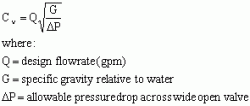
For our system:
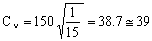
At this point, some people would be tempted to go to the valve charts or characteristic curves and select a valve. Don't make this mistake, instead, proceed to Step #4!
Step #1: Define the System
The system is pumping water from one tank to another through a piping system with a total pressure drop of 150 psi. The fluid is water at 70 °F. Design (maximum) flowrate of 150 gpm, operating flowrate of 110 gpm, and a minimum flowrate of 25 gpm. The pipe diameter is 3 inches. At 70 °F, water has a specific gravity of 1.0.
Key Variables: Total pressure drop, design flow, operating flow, minimum flow, pipe diameter, specific gravity
Step #2: Define a maximum allowable pressure drop for the valve
When defining the allowable pressure drop across the valve, you should first investigate the pump.
Step #3: Calculate the valve characteristic
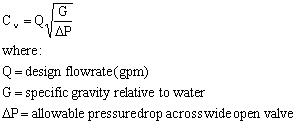
For our system:
At this point, some people would be tempted to go to the valve charts or characteristic curves and select a valve. Don't make this mistake, instead, proceed to Step #4!
16 Comments
Hi, Chris
I'm Emad Elgebesy. Senior process engineer in Worley Parsons. First of all, thanks for your clear efforts on the community, And im willing to share my experiance in this regard.
In Worley Parsons, we did the valve calculation for, single phase & two phase. The above mentioned calculation did not demonstrate which phase is, But i think this liquid phase valve calculation only.
After calculating the Cv, Supplier should verify the strock range (10% to 90%) is commnly used, noise level& body size as well.
Finally, there is many free control valve software of FirstVue do regirous calculation
Regards
Emad
thanks for the info Chris
Dear Chris,
If the vendor did not supply the valve chart, is there any we can get the control valve opening by using calculated Cv and rated Cv?
Cv charts are generally made for experimental data. If your valve supplier doesn't have a Cv chart for a valve that they sold to you...find a new valve supplier...that is not acceptable.
Chris,
Nice article!
I'd like to make a suggestion for a follow-up article. There are many times that we size liquid control valves in systems where the source pressure comes from a gas in the system instead of a pump (I am thinking of scrubber dump valves). In these situations, after sizing the liquid valve, we often need to determine the "gas blowby" rate, which is how much gas would flow through the valve if the liquid level control loop failed and left the valve wide open. This is often required when sizing pressure safety valves further downstream in the system. It would be great to add an additional step to this article to calculate the maximum gas flow through the selected liquid control valve.
Regards,
Paul
Great job
Thanks Chris
Really Helpful post for someone like me who is recent graduate, explained in very easy way.
I have few questions.
1. is this procedure and equations are useful for compressible fluids/ Gases
2. Do you have anything for selecting control valve for compressible fluids/gases ? (Explaining Nice and easy with thumb rules for selection criteria, like gain should never be less than 0.5 etc.)
I found a handbook from Emerson on control valve. That procedure seems to be too complicated or theoretical.( Too many contents no thumb rules ) Page 118 of Fisher control valve handbook, Emerson (its free on google - couldn't post the link)
Beautiful thanks Chris
Dear all,
In maximum case of flowrate, why the pressure dropcontrol valve should have the minimum limitation?
For example, when calculating hydraulic balance, at max case ( 120% normal flowrate), the pressure drop of control valve for liquid service is from 0.5 to 1 kg/cm2?
In my opinion, if the pressure drop of CV is too small, the Cv of CV will be very big. Therefore, even though the CV is full open at max. case, CV can not control the flowrate is the case, right?