
 Forums
 Blogs
Blogs Articles
 File Library
 FAQ
FAQ Search
 FB
FB


I have one basic question on depressurization valves on vessels.
Why depressurization valves on vessels are needed (in addition to PSV)?
I am confused between depressurizing vessel before vessel material reaches ~1200 deg. F (deformation temperature) in fire case or reducing metal temperature by Joule-Thompson effect to keep metal temperature below deformation temperature.
Thank you in advance.
|
|

Depressurization Valves
Started by Krishna2579, Mar 12 2009 05:59 AM
5 replies to this topic
Share this topic:
#2

Art Montemayor
-

- Admin
-

- 5,782 posts
Gold Member
Posted 12 March 2009 - 07:58 AM
Krishna:
This subject has been pounded, expounded and discussed in several threads within the Pressure Relief Forum. If you use the SEARCH feature, you will find these threads and the answer(s) to your question.
Since you are a new member (and probably a recent graduate), I'll give you a quick highlight of the reasons for depressurization of pressure vessels (but I would expect you to use the SEARCH feature and read the other threads as well):
First, and foremost, not all vessels require depressurization. If you are a Chemical Engineer, you will appreciate the fact that vessels containing liquids while exposed to an external pool fire actually have a heat sink reservoir in the form of the latent heat of vaporization of the contained liquid. In other words, the external fire heats the vessel walls but the contained liquid serves to keep the vessel relatively cool while it, in turn, is vaporized. It is when the liquid inventory is totally vaporized that the vessel is exposed to serious mechanical damage by the impinging external fire (if it still continues). Therefore, to avoid a catastrophic vessel structural failure (due to the rapid weakening of the allowable stress on the material of construction) the internal pressure is vented away (usually to the atmosphere if a flare is not available). The vessel will still collapse if maintained under fire, but at least it will not shatter or explode.
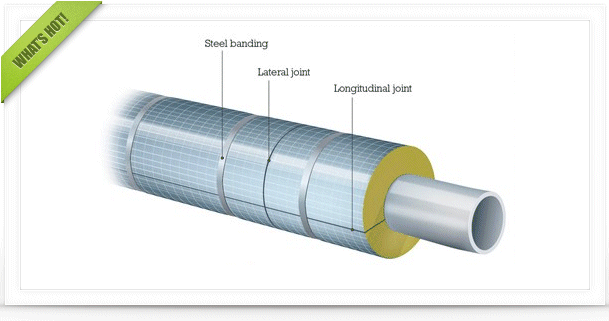
A pressure vessel filled with gas (especially at high pressure) that is exposed to an external pool fire is under a precarious and potentially dangerous situation because it does not have a heat sink that will absorb the enveloping heat source. Additionally, to make matters worse, the heat transfer coefficient for a gas film is the lowest in nature and therefore the heat transfer across the vessel walls is very inefficient. The internal gas pressure will increase – but at a relatively slow pace. Since the heat transfer is slow across the vessel walls, these same walls will increase rapidly in temperature and reach a level that is above their safe allowable stress with respect to the contained internal pressure. The potential result is a vessel rupture or explosion – either of which would inflict serious and deadly damage to the surroundings and adding to the external fire. To avoid such a deadly scenario, a depressurization is designed and activated on pressurized gas vessels. Additionally, protective insulation and fire sprinklers may add protection to the vessel during a pool fire. However, not much faith should be put on external insulation since this type of defense tends to decompose or come apart during a fire.
Read API 520 (both parts 1 and 2) as well as API 521 in order to capture a lot of the specific details and concerns that surround the pool fire scenario with respect to gas-filled pressure vessels.
This subject has been pounded, expounded and discussed in several threads within the Pressure Relief Forum. If you use the SEARCH feature, you will find these threads and the answer(s) to your question.
Since you are a new member (and probably a recent graduate), I'll give you a quick highlight of the reasons for depressurization of pressure vessels (but I would expect you to use the SEARCH feature and read the other threads as well):
First, and foremost, not all vessels require depressurization. If you are a Chemical Engineer, you will appreciate the fact that vessels containing liquids while exposed to an external pool fire actually have a heat sink reservoir in the form of the latent heat of vaporization of the contained liquid. In other words, the external fire heats the vessel walls but the contained liquid serves to keep the vessel relatively cool while it, in turn, is vaporized. It is when the liquid inventory is totally vaporized that the vessel is exposed to serious mechanical damage by the impinging external fire (if it still continues). Therefore, to avoid a catastrophic vessel structural failure (due to the rapid weakening of the allowable stress on the material of construction) the internal pressure is vented away (usually to the atmosphere if a flare is not available). The vessel will still collapse if maintained under fire, but at least it will not shatter or explode.
A pressure vessel filled with gas (especially at high pressure) that is exposed to an external pool fire is under a precarious and potentially dangerous situation because it does not have a heat sink that will absorb the enveloping heat source. Additionally, to make matters worse, the heat transfer coefficient for a gas film is the lowest in nature and therefore the heat transfer across the vessel walls is very inefficient. The internal gas pressure will increase – but at a relatively slow pace. Since the heat transfer is slow across the vessel walls, these same walls will increase rapidly in temperature and reach a level that is above their safe allowable stress with respect to the contained internal pressure. The potential result is a vessel rupture or explosion – either of which would inflict serious and deadly damage to the surroundings and adding to the external fire. To avoid such a deadly scenario, a depressurization is designed and activated on pressurized gas vessels. Additionally, protective insulation and fire sprinklers may add protection to the vessel during a pool fire. However, not much faith should be put on external insulation since this type of defense tends to decompose or come apart during a fire.
Read API 520 (both parts 1 and 2) as well as API 521 in order to capture a lot of the specific details and concerns that surround the pool fire scenario with respect to gas-filled pressure vessels.
#3
ARAZA
-

- Members
-

- 80 posts
Gold Member
Posted 12 March 2009 - 09:25 AM
Art,
Good Explanation.
I agree that installing a PSV on a gas filled vessel does not go any good except that it gives a little more for firefighting. Pressure in a gas filled vessel will give rise very rapidly, to avoid rapid overpressure, I've seen companies relying on fire rated (Stainless Steel) insulaton and good fire figthing capabilities in the plant. For instance Marathon oil adopts this practice across North America.
ASME section 8 div.1 demands that all pressure vessels designed per ASME code needs to have PSV installed, regardless whether there are overpressure scenarios or not. I always, recommends a PSV for all vessels including gas filled vessel which most of the time end up being isulation for fire rated insulation.
Interesting to know what your experience had been so far on this subject.
ARAZA
Good Explanation.
I agree that installing a PSV on a gas filled vessel does not go any good except that it gives a little more for firefighting. Pressure in a gas filled vessel will give rise very rapidly, to avoid rapid overpressure, I've seen companies relying on fire rated (Stainless Steel) insulaton and good fire figthing capabilities in the plant. For instance Marathon oil adopts this practice across North America.
ASME section 8 div.1 demands that all pressure vessels designed per ASME code needs to have PSV installed, regardless whether there are overpressure scenarios or not. I always, recommends a PSV for all vessels including gas filled vessel which most of the time end up being isulation for fire rated insulation.
Interesting to know what your experience had been so far on this subject.
ARAZA
#4
Qalander (Chem)
-

- ChE Plus Subscriber
-
- 829 posts
Gold Member
Posted 12 March 2009 - 10:20 AM
Dear Art.
Although repeat question in a way,even after pointing this out you replied as well.
You are a great stallwart.I must admire.
Best Regards
Qalander
Although repeat question in a way,even after pointing this out you replied as well.
You are a great stallwart.I must admire.
Best Regards
Qalander
#5
Krishna2579
-
- Members
-
- 4 posts
Brand New Member
Posted 13 March 2009 - 04:12 AM
QUOTE (Art Montemayor @ Mar 12 2009, 06:28 PM) <{POST_SNAPBACK}>
Krishna:
This subject has been pounded, expounded and discussed in several threads within the Pressure Relief Forum. If you use the SEARCH feature, you will find these threads and the answer(s) to your question.
Since you are a new member (and probably a recent graduate), I'll give you a quick highlight of the reasons for depressurization of pressure vessels (but I would expect you to use the SEARCH feature and read the other threads as well):
First, and foremost, not all vessels require depressurization. If you are a Chemical Engineer, you will appreciate the fact that vessels containing liquids while exposed to an external pool fire actually have a heat sink reservoir in the form of the latent heat of vaporization of the contained liquid. In other words, the external fire heats the vessel walls but the contained liquid serves to keep the vessel relatively cool while it, in turn, is vaporized. It is when the liquid inventory is totally vaporized that the vessel is exposed to serious mechanical damage by the impinging external fire (if it still continues). Therefore, to avoid a catastrophic vessel structural failure (due to the rapid weakening of the allowable stress on the material of construction) the internal pressure is vented away (usually to the atmosphere if a flare is not available). The vessel will still collapse if maintained under fire, but at least it will not shatter or explode.
A pressure vessel filled with gas (especially at high pressure) that is exposed to an external pool fire is under a precarious and potentially dangerous situation because it does not have a heat sink that will absorb the enveloping heat source. Additionally, to make matters worse, the heat transfer coefficient for a gas film is the lowest in nature and therefore the heat transfer across the vessel walls is very inefficient. The internal gas pressure will increase – but at a relatively slow pace. Since the heat transfer is slow across the vessel walls, these same walls will increase rapidly in temperature and reach a level that is above their safe allowable stress with respect to the contained internal pressure. The potential result is a vessel rupture or explosion – either of which would inflict serious and deadly damage to the surroundings and adding to the external fire. To avoid such a deadly scenario, a depressurization is designed and activated on pressurized gas vessels. Additionally, protective insulation and fire sprinklers may add protection to the vessel during a pool fire. However, not much faith should be put on external insulation since this type of defense tends to decompose or come apart during a fire.
Read API 520 (both parts 1 and 2) as well as API 521 in order to capture a lot of the specific details and concerns that surround the pool fire scenario with respect to gas-filled pressure vessels.
This subject has been pounded, expounded and discussed in several threads within the Pressure Relief Forum. If you use the SEARCH feature, you will find these threads and the answer(s) to your question.
Since you are a new member (and probably a recent graduate), I'll give you a quick highlight of the reasons for depressurization of pressure vessels (but I would expect you to use the SEARCH feature and read the other threads as well):
First, and foremost, not all vessels require depressurization. If you are a Chemical Engineer, you will appreciate the fact that vessels containing liquids while exposed to an external pool fire actually have a heat sink reservoir in the form of the latent heat of vaporization of the contained liquid. In other words, the external fire heats the vessel walls but the contained liquid serves to keep the vessel relatively cool while it, in turn, is vaporized. It is when the liquid inventory is totally vaporized that the vessel is exposed to serious mechanical damage by the impinging external fire (if it still continues). Therefore, to avoid a catastrophic vessel structural failure (due to the rapid weakening of the allowable stress on the material of construction) the internal pressure is vented away (usually to the atmosphere if a flare is not available). The vessel will still collapse if maintained under fire, but at least it will not shatter or explode.
A pressure vessel filled with gas (especially at high pressure) that is exposed to an external pool fire is under a precarious and potentially dangerous situation because it does not have a heat sink that will absorb the enveloping heat source. Additionally, to make matters worse, the heat transfer coefficient for a gas film is the lowest in nature and therefore the heat transfer across the vessel walls is very inefficient. The internal gas pressure will increase – but at a relatively slow pace. Since the heat transfer is slow across the vessel walls, these same walls will increase rapidly in temperature and reach a level that is above their safe allowable stress with respect to the contained internal pressure. The potential result is a vessel rupture or explosion – either of which would inflict serious and deadly damage to the surroundings and adding to the external fire. To avoid such a deadly scenario, a depressurization is designed and activated on pressurized gas vessels. Additionally, protective insulation and fire sprinklers may add protection to the vessel during a pool fire. However, not much faith should be put on external insulation since this type of defense tends to decompose or come apart during a fire.
Read API 520 (both parts 1 and 2) as well as API 521 in order to capture a lot of the specific details and concerns that surround the pool fire scenario with respect to gas-filled pressure vessels.
Thanks a lot Art,
Infact there are many discussions on this topic in this forum.
Inspite of topic being covered several times you spared your precious time.
Thank you once again.
#6
Krishna2579
-
- Members
-
- 4 posts
Brand New Member
Posted 13 March 2009 - 04:15 AM
Thank you Qalander and RAZA
Similar Topics
Parallel Control Valves Downstream Relief ScenarioStarted by Guest_pklavinsJ_* , 18 Jun 2025 |
|

|
||

Breather Valves - Liquid Movement In Breathing ScenarioStarted by Guest_panoska_* , 14 Dec 2024 |
|

|
||
Isolation Requirement For Bypass Valves/ Movs.Started by Guest_shantanu.ghag_* , 15 Sep 2024 |
|

|
||
Hydrogen Storage Tank Depressurization Duration - For Maintenance!Started by Guest_panagiotis_e_* , 11 Jul 2024 |
|

|
||
Pressure Regulators Vs Control ValvesStarted by Guest_panoska_* , 19 Jun 2024 |
|

|

