
 Forums
 Blogs
Blogs Articles
 File Library
 FAQ
FAQ Search
 FB
FB
Chemical and Process Engineering Resources


While oil prices continue to climb, energy conservation remains the prime concern for many process industries. The challenge every process engineer is faced with is to seek answers to questions related to their process energy patterns.
A few of the frequently asked questions are:
- Are the existing processes as energy efficient as they should be?
- How can new projects be evaluated with respect to their energy requirements?
- What changes can be made to increase the energy efficiency without incurring any cost?
- What investments can be made to improve energy efficiency?
- What is the most appropriate utility mix for the process?
- How to put energy efficiency and other targets like reducing emissions, increasing plant capacities, improve product qualities etc, into a one coherent strategic plan for the overall site?
All of these questions and more can be answered with a full understanding of Pinch Technology and an awareness of the available tools. for applying it in a practical way. This article aims to provide the basic knowledge of the concepts in pinch technology and how they have been be applied across a wide range of process industries.
What is Pinch Technology
Meaning of the Term "Pinch Technology"
The term "Pinch Technology" was introduced by Linnhoff and Vredeveld to represent a new set of thermodynamically based methods that guarantee minimum energy levels in design of heat exchanger networks. Over the last two decades it has emerged as an unconventional development in process design and energy conservation. The term ‘Pinch Analysis’ is often used to represent the application of the tools and algorithms of Pinch Technology for studying industrial processes. Developments of rigorous software programs like PinchExpressTM, SuperTargetTM, Aspen PinchTM have proved to be very useful in pinch analysis of complex industrial processes with speed and efficiency.
Basis of Pinch Analysis
Pinch technology presents a simple methodology for systematically analysing chemical processes and the surrounding utility systems with the help of the First and Second Laws of Thermodynamics. The First Law of Thermodynamics provides the energy equation for calculating the enthalpy changes (dH) in the streams passing through a heat exchanger. The Second Law determines the direction of heat flow. That is, heat energy may only flow in the direction of hot to cold. This prohibits ‘temperature crossovers’ of the hot and cold stream profiles through the exchanger unit. In a heat exchanger unit neither a hot stream can be cooled below cold stream supply temperature nor a cold stream can be heated to a temperature more than the supply temperature of hot stream. In practice the hot stream can only be cooled to a temperature defined by the ‘temperature approach’ of the heat exchanger. The temperature approach is the minimum allowable temperature difference (DTmin) in the stream temperature profiles, for the heat exchanger unit. The temperature level at which DTmin is observed in the process is referred to as "pinch point" or "pinch condition". The pinch defines the minimum driving force allowed in the exchanger unit.
Objectives of the Pinch Analysis
Pinch Analysis is used to identify energy cost and heat exchanger network (HEN) capital cost targets for a process and recognizing the pinch point. The procedure first predicts, ahead of design, the minimum requirements of external energy, network area, and the number of units for a given process at the pinch point. Next a heat exchanger network design that satisfies these targets is synthesized. Finally the network is optimized by comparing energy cost and the capital cost of the network so that the total annual cost is minimized. Thus, the prime objective of pinch analysis is to achieve financial savings by better process heat integration (maximizing process-to-process heat recovery and reducing the external utility loads). The concept of process heat integration is illustrated in the example discussed below.
A Simple Example of Process Integration by Pinch Analysis
Consider the following simple process [Figure 1a] where feed stream to a reactor is heated before inlet to a reactor and the product stream is to be cooled. The heating and cooling are done by use of steam (Heat Exchanger -1) and cooling water (Heat Exchanger-2), respectively. The Temperature (T) vs. Enthalpy (H) plot for the feed and product streams depicts the hot (Steam) and cold (CW) utility loads when there is no vertical overlap of the hot and cold stream profiles.
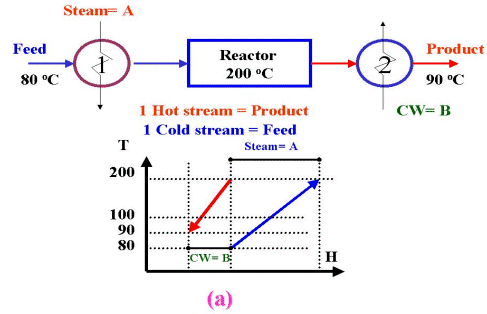 | 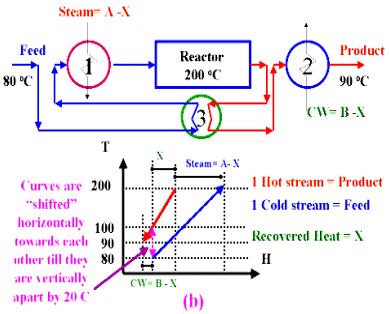 |
| Figure 1a: A Simple Flow Scheme with T-H profile | Figure 1b: Improved Flow Scheme with T-H profile |
An alternative, improved scheme is shown in Figure 1b where the addition of a new ‘Heat Exchanger–3’ recovers product heat (X) to preheat the feed. The steam and cooling water requirements also get reduced by the same amount (X). The amount of heat recovered (X) depends on the ‘minimum approach temperature’ allowed for the new exchanger. The minimum temperature approach between the two curves on the vertical axis is DTmin and the point where this occurs is defined as the "pinch". From the T-H plot, the X amount corresponds to a DTmin value of 20 oC. Increasing the DTmin value leads to higher utility requirements and lower area requirements.
0 Comments